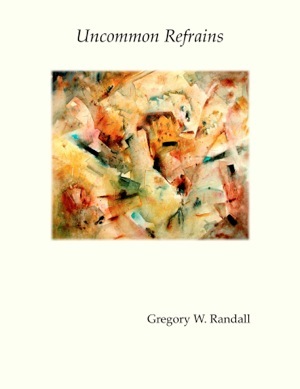
We are conditioned, those of us who love books, to expect in the narratives we read either happiness or tragedy. Every novel, memoir, poetry collection must contain in its pages a thread that drives us from one point to another, from the beginning to the end. Therefore, I needed to read Gregory W. Randall‘s poetry chapbook, Uncommon Refrains (from The Lives You Touch Publications), twice before I could even come close to understanding that it isn’t really about the narrative thread. It begins in a hospital and of course I expected to read about either recovery or death, but instead, Randall’s poems describe the experience, not the journey. It’s true the book is divided into sections that suggest a narrative (The Hospital Stay, Grace Notes, and finally Homecomings) but even so, the philosophy of the poems doesn’t travel in one direction.
The book opens with a single poem that is outside of the sections titled, “A Sort of Nocturne.” This poem begins with a description of driving on the highway which is in actuality an opposition to travel: the narrator instructs his wife to pretend that they haven’t driven for hours on the way to the hospital. Pretend all the difficulty of a severe illness didn’t happen, the phone calls, the “dilemma over / whether I stay behind to keep our life afloat,” the lack of sleep. At the end, the reader realizes what the narrator already knows. This terrible moment in their lives is “almost seasonal-a cycle without end.” This tragedy happens all the time, to many people, as well as to the larger universe so that we’re all truly just living in the midst of “an exhaustible dark.” A reader might think the poem is a tragedy in the truest sense, except that Randall also insists what we have is “luminous,” like stars. The poem sets up the rest of the collection perfectly: though we live with difficulty, joy has hold of us as well. Life is both a “luminous spark” as well as “an inexhaustible dark.”
The other poems illustrate this ying-yang philosophy. Some are tragic, like the title poem of the book, “Uncommon Refrains.” It ends with the idea that “we’ll never swim so deep again.” Nothing lasts. The next poem, “Unusual Patterns,” insists upon educating the reader about how what we choose to do forms a weave in which our understanding is altered. People may misinterpret this strange pattern, but that doesn’t render it any less valid. The rest of this section continues this idea while illustrating the narrator’s interaction with his wife’s sick daughter. She has had a stroke and is in the hospital enduring brain surgeries. The narrator speaks of the hospital and their relationships with love and compassion.
The second part of the collection, “Grace Notes,” illuminates the narrator’s relationship with the sick woman’s daughter. He sees the girl’s youth, her incredible resilience as she deals with her mother’s illness and is amazed. In “Girl Reading,” the narrator states, “you amaze me with your / burgeoning language.” as if her growth is in direct opposition with her mother’s decline. The other poems of this section, cleverly titled as a reflection on the girl’s name, Grace, continue this fascination with health and change, but ultimately, the last one ends with this, “we’re left to wonder / how much longer / any of us will really know you.” Uncertainty creeps back into the poems and once again I’m reminded that this collection encompasses more than narrative. This isn’t a story with a beginning, middle, and end, despite the suggestion of it that threads through the pages.
The last section focuses on the narrator’s wife, the sick woman’s mother, the girl’s grandmother. These poems are fraught with waiting, with the silences that populate a house when one of its occupants is missing. The house isn’t just a building, but a metaphor for their relationship. When tragedy strikes, we often think of going back to the moment right before, when everything seems well. We expect to return when the disaster is over. Of course, this is impossible. “Legitimate Desires” ruminates on this when the narrator states, “isn’t this legitimate desire / to go back / and reclaim the irretrievable hours / why we linger in the pool” as if to cling to that need, but life is dangerous. Relationships are fragile. In “Re-entry” Randall writes, “I’m so aware of your absent heaviness / that I grab your sleeve, hold onto you / tenuous as a kite.”
Taken separately, some of Randall’s poems might seem tragic, some hopeful. When read altogether, the poems give birth to a different idea: that reality is constructed of those moments that we live right now, this very moment. The past and the future are both creations we make up to give us a framework on which to hang the chaotic present. So, too, is this book of poems constructed around the three females most important to the narrator, decorated by the tragedy of the stroke his wife’s daughter suffers and subsequent brain surgeries. Ultimately, we humans live in the inexhaustible dark. The trick, this book seems to say, is to accept this and live in the present’s luminous spark.
11 January 2011, Christine Klocek-Lim






 Christine Klocek-Lim