Whale Sound has two of my poems. . .

 . . . and Nic Sebastian’s voice is sublime as she reads them. Go, go, go listen:

Raguel

Boulder Caves

I love this new project, Whale Sound. It’s introduced me to some fantastic work by poets I’d not read before, and listening to someone read them has illuminated the poems in a way that I didn’t expect. When I write a poem, I hear what it sounds like in my head, in my voice, and when I read it aloud, I try to preserve that emotion and sense of pacing. Listening to someone else read my poems is the ultimate test: did I succeed in conveying what I intended in that poem? Did I put enough space in between the imagery so that a reader can feel what I wanted as they read the poem?

My favorite poem at Whale Sound is He Calls Her Etsy by Karen Shubert. I love this poem. I love Nic’s voice as she reads this poem, the fragile wonder of love and sunlight that she manages to infuse within the lines. I can imagine the scene so clearly and then the last line devastates me. Listen and be amazed.

Thank you Nic, for your incredible contribution to the world of poetry. I am so very honored.

Poetry Book Blog Tour: Interview with Joanne Merriam

Yes, it’s part 5 of the Poetry Book Blog Tour! Today I interview Joanne Merriam:


Joanne Merriam is a supremely talented writer with books, prizes, and numerous publication credits to her name. She was nominated for the 2009 Dwarf Stars Award, winner of Asimov’s Science Fiction‘s Readers’ Awards for Best Poem of 2008, for “Deaths on Other Planets,” and First and Third place winner (respectively) of the Strange Horizons 2005 and 2004 Reader’s Choice Awards for Fiction.

Belinda Cooke explains Joanne’s poetry book, “The Glaze from Breaking,” thus: “She reminded me a lot of the early work of Boris Pasternak where the poet does not so much observe the natural world as fuse with it breaking down the boundaries between speaker and landscape… She also does clever things with sound… [and] has the odd image that manages to be both unusual and just right.”


On to the interview:
(CKL): Nearly twenty years ago, I visited the Morgan Library in Manhattan and saw Sylvia Plath’s crayon printed first attempts at poetry. Since then, I’ve always enjoyed reading the very early poems of poets. Have you saved any of your first attempts? 
(JM): I no longer have any of my very early work – I started writing when I
was eight and the earliest poems I have are from my very late teens.
Here’s one of them, written when I was 19 (also my earliest published
poem–after some stuff that appeared in a tiny local magazine which I
lost in one of my many moves–it was in the Spring 1996 issue of Feux
chalins):
Enough
To be with you in the early hours of the evening is enough.
To watch your back and shoulders move under your shirt, to smilingly
feel your eyes on me is enough.
Yes, I want to feel your hands tangled in my hair, yes, I want to run
my fingers along the smooth soft skin of your wrists and arms, and
yes, I want to rake my calves over your calves.
But more than that I need only to observe you move across the room I’m in.
You don’t have to do anything.
It is enough to hear your low voice talk or laugh, or say my name,
and, not touching, while talking and laughing, to feel near me your
long lean warmth.
Here’s a very recent poem (published here
and written in April 2010):
Ah Inflorescence
         (after Walt Whitman’s ‘Ah Poverties, Wincings and Sulky Retreats’)
You’re an umbel–
your shoots; your loosenesses; your legs like pedicels;
eyes dark flat seeds screwed nearly shut against the light;
woodbine nerves; you seacoast angelica
(for what are your heteroflexible hands on my skin
but a flower moving, seeds drifting on a breeze?)–
when you finally touch me (my hands the dumbest of any)
(fingernails red petals on white sheets) I pluck you
(a cluster of flowers comes undone;
grinds into the ground)

(CKL): What changed in your work from the beginning to where you are now?
(JM): Well, obviously in the interim I lost my virginity.
I learned a lot about the craft of writing in my twenties, and am much
more comfortable now using metaphor and internal rhymes. I also
figured out somewhere along the way that line breaks are useful. I’m
more comfortable with interrupting my syntax and generally less
prosey.
But more than that, my whole approach has changed. As much as my life
inescapably informs my work, I’m not drawing from autobiography in
quite the same way (and sometimes hardly at all, especially in my
science fiction poetry). “Enough” was a deeply personal poem for me
when I was 19, but while “Ah Inflorescence” is about a real person, I
didn’t write it to express emotions I couldn’t figure out how to
express outside my writing, or for therapy. When I was a teenager,
writing a poem was almost always a stand-in for having a real
conversation with a real person–it was safer and less messy, because
I didn’t have to deal with the other person at all. Now, although I
frequently write about my life, it’s not a replacement for
communicating with my loved ones.

(CKL): Why did you start writing?
(JM): Despite what I’ve just said, not for therapy. I started writing when I
was eight because I was (and am) a people-pleaser, and my grade three
teacher praised a poem I had written for class. It was a rhyming poem
called “Dryad Lake” and was very derivative of the Anne of Green
Gables books. I wish I still had a copy. My parents liked it too. I
liked pleasing all these adults, so I wrote some more. At some point I
fell in love with the actual process of writing and now I can’t stop.
I get really crotchedy if I go awhile without writing anything.

(CKL): Do you still like to write or is it a chore?
(JM): Both. It’s a chore which I enjoy. I like the mental stimulation, the
necessary extended focus, and the sense of accomplishment when I
complete something. I like being part of a conversation that’s bigger
than me.

(CKL): Do you write anything other than poetry?
(JM): Yes, I also write fiction, both literary and speculative (science
fiction, fantasy, horror). I’ve finished the first draft of a novel,
which needs catastrophic edits before it’ll be any good, and have
written a bunch of short stories, which have been published in places
like The Fiddlehead, Stirring and Strange Horizons. I’m also working
on a web comic with my roommate, who is an artist, but we haven’t
gotten to the point where anything is ready to post online.

(CKL): Was getting a book published what you expected?
(JM): Ha. Not even remotely. I had some kind of an idea that having a book
published would open doors for me, involve some small sort of
celebrity, make me into a real writer. It’s nice to be able to say I
had a book out when I tell people I’m a writer, but it really hasn’t
changed anything at all.
And the whole process was quite a bit of a struggle, as I had to do a
lot more marketing than I’d expected. Not that I didn’t expect to have
to market my work, because by 2005 when the book came out I knew
enough to know that publishers, especially poetry publishers, have
very little money. But I made the mistake of choosing a UK publisher
who had no North American distribution. Stride Books was otherwise
absolutely fantastic in every possible way; I just lived on the wrong
continent.
It also came out just after I immigrated to the US from Canada, and I
was in that dead period many immigrants face when you’re not allowed
to work in the country (lest you be deported), and you’re not allowed
to leave the country (or you’ll have to start the whole process over
again). So I had no money. My husband was working at a used car
dealership (you can read about his experience here:
and making just barely enough to keep us afloat. I didn’t have the
money for gas to drive to readings, let alone organize any sort of
promotional tour. What I had was time, and an internet connection, so
I did most of my marketing online, which was a great learning
experience.
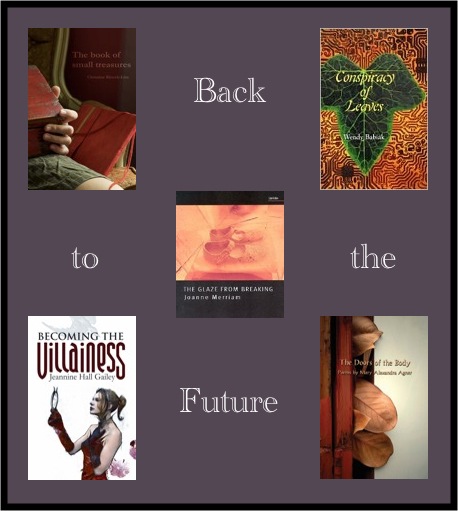

See the rest of the week:
27 July: Jeannine hosts Christine (that’s me!)
28 July: Wendy hosts Mary
29 July: Mary hosts Jeannine
30 July: Christine hosts Joanne

Short interview at Everyday Intensity

Thanks to Tania Pryputniewicz of The Fertile Source, I had the opportunity to answer a couple of questions about a subject near and dear to me: being a poetry editor. She has a guest spot on the lovely blog Everyday Intensity where she talks about being an editor. Then she asked me and Marjorie Tesser, editor of The Mom Egg, some questions about editing. Go check it out!

Guest Post by Tania Pryputniewicz: “So You Say You’re a Poetry Editor…”

.

How to photograph the heart

You remember how the lens squeezed
unimportant details into stillness:
the essential trail of rain down glass,
the plummet of autumn-dead leaves,
your grandfather’s last blink when
the breath moved on.
Your startled hands compressed
the shutter when you realized: this is it,
this is the last movement he will take
away from the silent fall of morphine,
beyond the soft gasp of the nurse,
past the sick, slow thud of your heart
moving in the luminous silence.
I wrote this in 2005 after I spoke with my mother about my grandmother’s death. It is not autobiographical, yet it is in the way that poems draw truth from real experiences. I’ve always found that odd about writing. It’s the title poem from my first chapbook, “How to photograph the heart,” (The Lives You Touch Publications).
-Christine Klocek-Lim

First Crocus

Since the first crocus of the season popped up last week, even with all the snow still on the ground, posting an old poem of mine seemed appropriate:


First Crocus
 
This morning, flowers cracked open
the earth’s brown shell. Spring
leaves spilled everywhere
though winter’s stern hand
could come down again at any moment
to break the delicate yolk
of a new bloom.

The crocus don’t see this as they chatter
beneath a cheerful petal of spring sky.
They ignore the air’s brisk arm
as they peer at their fresh stems, step
on the leftover fragments
of old leaves.

When the night wind twists them to pieces,
they will die like this: laughing,
tossing their brilliant heads
in the bitter air.


© Christine Klocek-Lim, first appeared on About.com, Poems for Spring, 2007

Ten years of internet poetry (is poetry dead?)

I like to tell people that I’ve been writing poetry since I was ten or eleven years old, and it’s true. I went to school to write, after college I went to work as a technical writer, and I wrote poems throughout my twenties, but I never seriously worked at it until 1999. I posted my first poem in an online workshop in 1997 and received scathing comments which sent me into hibernation for two more years. Then I decided I couldn’t wait any longer. I couldn’t wait for my kids to get older or easier, I couldn’t wait to have a better computer, I couldn’t wait for more time or sleep or space or any of those things you tell yourself you need in order to write.
By 2001 I was posting regularly at Poets.org and I learned how to let the nasty comments slide. I learned how take the helpful ones and use them to make my writing better. I didn’t submit often, but when I did I was mostly rejected. The few acceptances I received gave me the impetus to keep going. I learned that most of my writing was dreck because the stuff I read online was amazing. The people with whom I discussed poetry were intelligent and insightful, and their advice and commentary made me rethink everything I thought I knew about poetry. Ironically, these people were not widely published. They weren’t famous. The internet poets I knew were somewhat stigmatized, somewhat separated from the print poetry scene. Online publishing was somehow lesser and we all knew it.
I had to reevaluate the reasons I wanted to write: Did I want to be widely published? Well, yeah. Was that more important than the love of language, the thrill of writing something unique? Well, no, thankfully, because I’d finally accepted that being published wasn’t the point. It was the extra bonus, the frosting, the: oh yeah, by the way this is awesome when it happens. I wanted to continue online because it was easy to post poems. It was easy to meet other poets. I didn’t have to spend all my time writing snail-mail letters and waiting and waiting for a response. I didn’t have to spend a lot of money for an MFA I didn’t want and couldn’t afford with small children in the house. I was convinced that the web would change the face of the writing world; I just had to be patient.
I went back to the beginning and spent the next several years relearning the basics: metaphor and rhyme, meter and imagery, intent and audience. I still submitted, thought not a lot and the rejections continued, both online and snail mail. I kept writing because I loved that sensation of joy, the moment of creation that I felt when I really had a good line or image. I kept writing because I discovered that the more I wrote, the easier it was to find that joy. By 2009, I’d written four chapbooks, one full-length poetry manuscript, and two novels. I started submitting more, both online and via snail mail. All along this journey, I’ve posted poems online to Poets.org and other poetry workshops like Desert Moon Review, the Atlantic (now defunct), The Gazebo, and lurked at others just to learn: Eratosphere, Slate’s The Fray, etc. I’ve dealt with trolls, flame wars, and discrimination. I’ve been encouraged and helped and published in small poetry magazines, more often online than in print. I found that I love the flexibility of online publishing and started my own poetry journal, Autumn Sky Poetry, which now gets hundreds of submissions every few months, poems from writers who are beginners and from poets who have published widely.
Today is December 31, 2009. In the last year, I’ve won the 2009 Ellen La Forge Poetry prize. My manuscript, “Dark matter,” made semi-finalist in the Brittingham and Pollak Poetry Prizes (University of Wisconsin Press) and is a semi-finalist at the Philip Levine Prize in Poetry (waiting to hear about the winner). Today I found out that my freaky sci-fi poetry chapbook manuscript, “The Quantum Archives,” that I never, ever thought anyone would read let alone like made it to semi-finalist status at the Black Lawrence Press’ Black River Chapbook Competition. I’ve had two chapbooks published: “How to photograph the heart” by The Lives You Touch Publications and “The book of small treasures” by Seven Kitchens Press. It’s been a good ten years of waiting for the two worlds of poetry, online and print, to collide. And everything I’ve learned about writing is possible only because the internet has revitalized the poetry world. Right now, all of us who write poems are benefitting from the diversity and richness of the web. This online world made it possible for me to get to today: I don’t have an advanced degree and don’t teach. I do, however, love to write and because the internet made it possible for me to learn and meet other writers and put my work out into the virtual world, I’ve become part of a community of poets that didn’t exist fifteen years ago.
Is poetry dead? Not even a little.

List poem: This day on Twitter

 
Cute kitty is cute. #kitty!
 
Evil Twitter is evil and so is Facebook. #addicted
 
Lonesome tree has no leaves and is lonesome

above brown grass that is dead brown. #haiku
 
Early, you left so early today. #sad
 
Hot tea is so hot I burned my tongue. #damnit
 
Junk mail came late full of junk

and too much paper and dead trees. #sad
 
Quiet lunch is a sandwich and soup quietly 

steaming until it’s gone. #haiku
 
Pithy texts sent to my husband are pithy. #random
 
Sad news is sad–>no more NPR. #sad
 
Loud kids after school are really loud! #parenting
 
Hateful homework is still hateful even
 though
I’m a grownup. #homeworksuks #parenting
 
Evil Twitter is still evil–>so many 
links
to congenital heart defect stories. #chd #sad #addicted
 
Sarcastic teens are sarcastic and this is awesome. #not
 
Early, you came home so early. #love
 
Yummy dinner is yummy though kitty

stole morsel right from the pan. #badkitty!
 
Don’t tell my mom, but we can tell yours. #stillafraidofmom
 
Funny tv is funny, especially with sarcastic teens. #parenting
 
You say I am sleepy but so are you. #random #love
 
Cute kitty is so cute she must be dreaming. #kitty!


©2009 Christine Klocek-Lim
 

November poem-a first draft

.
November
Nine times four plus four
times I sing “Gloria” but god
sends no angels. I envision wings
and wind, feathers ruffling in the cold,
the November bluster dramatic as always,
but still no pale face, no stern demeanor.
If I am to be redeemed, I must save
myself. Emancipate the fingers, the skin
of the body, the bones beneath it all
until the heart is exposed, about to fly
off the spine and into the atmosphere,
but a cold front steps in before I can truly
conceive this winged organ. The last leaves
mutter as I walk the ridge, acknowledge
the view: a few storm clouds yet linger
while the fragile remnants of frost bite
at the ground. I kneel to remember
that hymn as I beseech the valley—
in excelsis. This part of the mountain
catches birds only to toss them out.
Sometimes they reach the ionosphere
where red sprites flee into thunder.
It’s a miracle any survive. No angel
could fly through such turbulence
though I imagine they try anyway.
Beneath me a stray feather jerks
between two rocks, a last transaction
destined to fail. I save it, splicing
the barbules together one last time
until suddenly, the wind catches it,
flicks it into the world, spinning
it madly away from me. I watch it fly
knowing I helped make that particular
moment, redemption unasked for,
the gift of freedom from a most
ordinary hand.
© 2009 Christine Klocek-Lim
.

Why write poetry? Review of "Touch: The Journal of Healing" Issue 2

Why write poetry?
This question is itself a cliché. For decades, centuries even, those of us who write have gone around muttering it under our breath. Sometimes we debate it over dinner and a glass of wine. Often a classroom holds the awkward silence of disinterested students after the teacher says the question aloud. And in the quietest corner of some souls the question drops into a journal like a stone on water, the result of a therapist’s suggestion to write down the pain.
For me, there are three possible answers to this question:
1. I write for myself. This is most often uttered by teens and sad people and those deluded few who have never read anything worthwhile enough to realize that most art is meant to be perused by someone other than oneself. If one shoves the writing into a closet, this is completely fine and I forgive you.
2. I write for everyone else. This is common among highly-educated folks, those who’ve spent a fortune on degrees and contest entries. These people want to be famous and love playing with the alphabet. This is also fine, as long as one doesn’t expect one’s mother to understand one’s latest work.
3. Last, there are those people who started out as #1, moved into #2, and then ended up somewhere completely different, realizing that though they love to play with words, they want even more for their words to touch others. The # 3s have had a hard time of it, spending money on contests, writing and sweating into the night with depressive misery. However, the best part of being a #3 (hey, can you tell which number I consider myself?) is the realization that art is meant to communicate something of the human condition to another person. The balance between self-absorption and the desperation for fame sometimes creates a poem that is worth reading.
In the recent issue of Touch: The Journal of Healing, there are several poems that reach this balance (disclaimer: I have two poems in this issue, so I’m biased), poems that talk about something so personal one almost cannot fit into the doorway of the poet’s soul. Tina Hacker’s poem, “Cutting It,” is one such poem. It deals with madness and birth and the desperate scrabbling of the individuals involved in this tragedy as they try to rescue a child from the depths of oblivion. The best part of the poem, for me, was the skillful handling of metaphor. Hacker used this device to convey the sense of loss inherent in mental deterioration: “he pushed out all her strength / and grew fragile as lace.” Not only does this passage refer to the act of giving birth, it also shows how the mother loses herself. In the next part of the poem the mother turns into scissors and cuts “holes into the lace,” leaving her parents to rescue her child as best they could. The grandfather slaps “the dust of madness / off his shirt and pants.” I have had a few bad years of my own, but never lost grip with reality, yet the poet still manages to convey the sorrow and frustration of this family in a way that I could understand, deeply. This is a poem that could have descended into either linguistic masturbation or navel-gazing dullness, but it doesn’t. It is perfect and wonderful.
Another poem in this issue that I loved was James S. Wilk’s “Dr. Helen Brooke Taussig.” I have never been a doctor, never even wanted to be one. In this poem, the narrator speaks about this woman as she practices medicine despite losing her hearing. The poet tells up bluntly how “She discarded her stethoscope” and then describes how the doctor’s fingers traced along the babies’ chests, “feeling for murmurs.” The poet then compares her facility with touch to a butterfly, giving the narrative a sense of lightness and joy, making a miracle out of loss. I could imagine what that must have felt like for her as she lost the one sense that was most important and necessary for her to practice her calling. Yet, the poem never descends into melancholy or cliche. Lovely work.
Another excellent poem, Larina Warnock’s, “Hospital Hush,” begins with a contradiction. Anyone who has ever spent time in a hospital knows that it is filled with noise, even in the dead of night; there is not such thing as “Hospital Hush.” The poem narrates the story of a parent watching over his/her gravely-ill child. The delightful thing about this poem is how the description of the noises profoundly contradicts the silent fear and sorrow of the parent. The very nature of those sounds (monitors, injections, doors clacking) illuminates the lack of news: the parent does not know if the child will get better. The silence of unknowing dwarfs the physical noise, creating a disharmony that is nearly unbearable. All this from a simple poem. The use of clear statments, “The door to room 24 in 10-North / of Doernbecher Children’s Hospital / clacks,” interspersed with parenthetical comments, “(no matter how / softly),” creates the reality for the reader. There is the real noise and then there are the murmurings the parent cannot help in the silence of his/her worry. Brilliant.
Unfortunately, not every poem in this issue speaks to me. For example, Kelly Grace Smith’s poem, “white lotus II,” seems to overflow with abstraction and superfluous language. It begins: “A single blossom / of bliss.” This is fine, except what is the “bliss?” Is is a person? A love-affair? A act of passion? I expected the metaphor to speak to me but in the second stanza, the reader is encouraged to believe that the narrator him/herself is the bloom: “I bloom only / in the dark of night.” How can one be both bliss and a bloom? The metaphor is broken over two concepts, neither of which are entirely believable. Unfortunately the poem continues in this vein, stumbling over such clichés as “beauty” and “ecstasy” and “suffering.” The most concrete detail is the reference to a “mountaintop.” Where is the human element? What part of this poem gives me something to which I can relate? I had no idea what was happening because the poem was composed entirely of pretty words and linebreaks. The poem might mean something to the poet but sadly it keeps readers from sharing the secret.
In the end, why even bother to ask “why write poetry?” Why sing? Why paint? Every piece of art begins with the soul of the artist, the voice of the poet wanting to get out. Sometimes it’s drivel and sometimes it’s a work so profound that the least one can do is share it with others, connect to a greater human community so that some reader in the world may take joy of it. If there’s even the slightest possibility of that happening I say, why the hell not?