Poet in Residence at Touch: The Journal of Healing

TouchTheJournalofHealing


For the past year, I have had the privilege of writing for Touch: The Journal of Healing as its Poet in Residence. I wrote a series of three essays focusing on the journals concept of Evolution into Insight: Experience. Intent. Craft.

It has been my pleasure to work with the editors, O.P.W. Fredericks and Daniel Milbo. Their friendship and editorial insight elevated my prose in a way I couldn’t have managed on my own.

If you’d like to read the essays, here are links to all three.

Experience – Evolution into Insight

Intent

Craft

Saturn’s moon Dione in slight color

from APOD 5 November 2012 — Image Credit: NASA, JPL, SSI, ESA; Post Processing: Marc Canale

_________________________________

Saturn’s moon Dione in slight color

Dione hangs over Saturn, craters leading.
Isn’t the face always the most battered
part of the body? This is what happens
when two things are locked together:
the dark forever in front of us,
an infinity of nothing
we can predict.

This morning you said you were sad,
and I grew sad.
It wasn’t raining,
but the sun felt like grief—
her bright, cool rays too much for me. Yesterday
you said you were tired and we slept
too soon, using the long hours
before moonset trying to dream.
Sometimes stars shoot down to Earth
on nights like that, but it’s hard to see
diamonds stuck in the side of 2 am.

Last week you said you wished we could move north,
where the sky is larger than the ground
and I thought of how we would live there:
burnt twigs for warmth, hands cupped
around water as best we could,
scuffing our marks on the planet
as winter moves in.

Dione is stuck with Saturn
though I doubt she knows how long it’s been.
We’ve had decades together, finding each
other’s socks on the wrong side
of the bed. Children coming and going.
We hurtle toward death as though we planned it
that way, though we never thought
we’d still be here, orbiting
each other, never alone.

Only slightly surprised.


© 2012 Christine Klocek-Lim

_________________________________

I wrote this poem in November, when things seemed terribly stressful. Of course, the stress didn’t last. Like fog drifting into nothing between the trees, it disappeared, and new difficulty replaced it, along with joy and discovery, and the sheer implacability of life walking on…

‘Tis the Season

xmas tree ball

Some of you may know that I sometimes write completely ridiculous holiday poems. Here they are—this year’s gem and a few earlier attempts. Enjoy!

__________________________________

‘Tis the Season

The malls are insane but you have to go shopping
for ribbon and candy to fill the last stocking.
You can’t stop to cry, ’tis the season for snow
and ice covered roads jammed with cars going slow
slow, so horribly … oh! There’s a dude dressed in red
on the side of the walk. He’s clutching his head
like someone hungover. His pants are all goopy:
the knees ripped right out, the butt kind of droopy.
You slow down to stare, but then offer a ride.
He kisses your cheek as he ducks down to hide.
“What the hell are you doing?” you ask and he smirks:
“Rudolph got wasted, went kind of berserk.”
You gape, shake your head. “Oh please, you’re not Santa.”
He shrugs and explains he was over Atlanta
when someone cracked open a bottle of whiskey.
“Three shots and the next thing I knew they’d got frisky.
Comet kicked Dasher right in the——”
“Stop!” you freak out, “Just keep your mouth shut.”
He laughs and you blush, thinking this must be a joke,
he can’t be St. Nick, he looks like a hoax.
“You can drop me right here,” he says while you frown.
“Prancer’s waiting right there, at the edge of the town.”
You slow down, still dubious, but the dude is quite right:
near the tree is a reindeer, head down, fur a fright.
“I told them they shouldn’t imbibe in December.
You’d think they’d believe me, or at least remember
the last time this happened.” He wrinkles his nose
and suddenly yells, “You dumbass! I almost froze!”
You freeze, not believing that Santa would curse,
but Prancer just snorts and throws up on your purse.
“Um—” you say, shocked. The reindeer looks sorry.
You gulp, and inch backwards: Santa’s no longer jolly.
He takes one step forward and scratches his ear—
the next thing you know there’s nothing but beer
left on top of the snow. And footprints. And barf.
You sigh, somewhat pissed, enough is enough,
but as you turn around twice to get out of sight
you trip on the vomit … UGH. What a night!
Next year, Santa please, don’t let them drink booze.
I’d like to go shopping … with clean shoes.

11 december 2012 — Christine Klocek-Lim

__________________________________

The 12 days of Catmas

On the first day of Christmas
my two cats gave to me
a dingleberry in a pine tree.

On the second day of Christmas
my two cats gave to me
two hair balls,
and a dingleberry in a pine tree.

On the third day of Christmas
my two cats gave to me
three dead mice,
two hair balls,
and a dingleberry in a pine tree.

On the fourth day of Christmas
my two cats gave to me
four pathetic howls,
three dead mice,
two hair balls,
and a dingleberry in a pine tree.

On the fifth day of Christmas
my two cats gave to me
five piles of poo,
four pathetic howls,
three dead mice,
two hair balls,
and a dingleberry in a pine tree.

On the sixth day of Christmas
my two cats gave to me
six stinging scratches,
five piles of poo,
four pathetic howls,
three dead mice,
two hair balls,
and a dingleberry in a pine tree.

On the seventh day of Christmas
my two cats gave to me
seven shredded sparrows,
six stinging scratches,
five piles of poo,
four pathetic howls,
three dead mice,
two hair balls,
and a dingleberry in a pine tree.

On the eighth day of Christmas
my two cats gave to me
eight hissy fits,
seven shredded sparrows,
six stinging scratches,
five piles of poo,
four pathetic howls,
three dead mice,
two hair balls,
and a dingleberry in a pine tree.

On the ninth day of Christmas
my two cats gave to me
nine fishy farts,
eight hissy fits,
seven shredded sparrows,
six stinging scratches,
five piles of poo,
four pathetic howls,
three dead mice,
two hair balls,
and a dingleberry in a pine tree.

On the tenth day of Christmas
my two cats gave to me
ten tons of fur,
nine fishy farts,
eight hissy fits,
seven shredded sparrows,
six stinging scratches,
five piles of poo,
four pathetic howls,
three dead mice,
two hair balls,
and a dingleberry in a pine tree.

On the eleventh day of Christmas
my two cats gave to me
eleven spitting kittens,
ten tons of fur,
nine fishy farts,
eight hissy fits,
seven shredded sparrows,
six stinging scratches,
five piles of poo,
four pathetic howls,
three dead mice,
two hair balls,
and a dingleberry in a pine tree.

On the twelfth day of Christmas
my two cats gave to me
twelve stolen salmon,
eleven spitting kittens,
ten tons of fur,
nine fishy farts,
eight hissy fits,
seven shredded sparrows,
six stinging scratches,
five piles of poo,
four pathetic howls,
three dead mice,
two hair balls,
and a dingleberry in a pine tree.

24 december 2011 — Christine Klocek-Lim

__________________________________

Mrs. Kringle’s Lament

They said we’d only get an inch of snow
but when I wake it’s covered up the road
and slush has pulled some branches down so low
my favorite tree looks like it might explode.

I trudge outside with gloves and scarf and salt
to promptly slip and fall upon my rear
before I even reach the curb. “Assault!”
I bitch, then freeze as something licks my ear.

I scoot away, my heart up in my throat
and think: a zombie! when the icy slop
slumps to the side like puke on glass. A coat
so cheery green it makes me want to pop

out both my eyes emerges next to me.
I groan and pinch my nose. I know that face.
Those bells. That burp. He’s grown a sparse goatee
which doesn’t quite enhance the scraggly lace

sewn on his cap. “Oh, you again!” he sneezes,
grabs my sleeve as though I’ll help him up.
Yeah, right. I dodge his drunken grasp and seize
his pointed, chilly ears. He drops his cup.

I just don’t care. He thrashes, tries to kick
but cannot get away. “Where’s the deer?”
I snarl. I wish that Santa’d get here quick
before his merry crew drinks all the beer.

“You think I’d rat out my best friends? Oh please!”
he cries, then vomits just as someone’s head
ducks out of sight behind the frosty trees
like Samurai Jack, but drunk. And wearing red.

“I know you’re there, you might as well come out,”
I call, my spirits sinking to despair
as I catch sight of antlers and a snout
crouched low behind my car. I swear.

This happens every year. No joyful bells
for me, oh no. Instead, delinquent elves,
escapees from St. Nick’s gift wrap cartels,
crash in my yard to sleep. “Show yourselves!”

I yell again, not hoping for too much.
Surprise, surprise, who waddles out? The Man.
Kris Kringle. Santa Claus. I blink and clutch
my head (I drop the elf). “What’s the plan?”

I ask. I hope he knows what’s happening.
He “ho-ho-ho’s” and sways a bit, then slips
and suddenly I feel the bitter sting
of cognizance: he’s drunk from feet to lips.

I sigh and drag his jolly ass to bed,
park the sleigh, coax Rudolph to the shed.
The elf I tuck into an extra room.
The beer, I’m sure, is gone, and none too soon.

10 december 2010 — Christine Klocek-Lim

__________________________________

 Don’t drink on xmas eve

It happened this past midnight clear:
three crazy elves and two drunk deer
crashed in the yard atop my sled
then slipped downhill against the shed.

The sky was dry, the sunset gone:
where in hell did they come from?
Their groans and moans kept me awake;
I knew there must be some mistake.

In the dark I clomped downhill
and yelled my ire into the chill:
“Don’t you know it’s xmas eve?
Be quiet or I will make you leave!”

The sudden hush, like blocks of ice,
fell on my ears (oh so nice!)
as elves and deer peered up at me
like I was Nick and they: debris.

“We lost our sleigh and drank the beer;
your backyard was so close and clear.
We just could not control our stumble—
here we fell in this great jumble!”

Then their chortles broke the calm.
I dragged them home to wait for dawn.
The barfing wasn’t too severe,
but have you heard of snoring deer?

Santa owes me big for this
I thought as one elf burped a kiss
but it wasn’t till I fell asleep
that Santa came for his lost sheep.

And beneath the tree? What was my take?
Three beers, two bells, and one fruitcake.

19 december 2007 — Christine Klocek-Lim

Publish online and kiss your Pushcart goodbye

This past April I did an interview series for National Poetry Month. During the series, one of the questions I asked was this:

Do you think there is a disconnect between academic poets/poetry and online poets/poetry?

Some of the people I interviewed declined to answer. Some said “I don’t know.” Some gave an in-depth explanation of why they thought there was a disconnect or not. In general, many of the people I interviewed truly believed that if there is still a disconnect in any way, it will not be around for much longer because the internet has become so much a part of our lives.

I’m not so sure.

It is human nature to strive for status. It is part of our psyche to work toward success because it brings with it so many rewards: respect, wealth, power. In an evolutionary world, this means that one’s offspring has a better chance of survival if one has power.

In a literary sense, the definition of success has traditionally meant publish, publish, win awards, publish, win some more awards, etc. The more one publishes, the more one’s work has a chance of survival long after the writer has died.

The introduction of a radically new medium (online publishing) into an established and entrenched process has upset this balance of power. The hegemony of traditional literary establishments is slowly eroding as the prevalence of online opportunities expands. The question is whether the traditional establishments will adapt and survive or hang on so tightly that they slow down the process of change. I think it can go either way: some will adapt and some will fossilize their procedures (publishing, awards, etc.), thus preserving their traditional authority for at least a while longer.

(One need only to read the many articles about the arrival of ebooks and the hysteria that is gripping traditional publishing houses (see the brouhaha surrounding Amazon, the big six, and the Department of Justice) to realize that a similar upset is slowly gripping the literary publishing world as well. What most people don’t realize is that the tipping point for commercial fiction is already here.)

Just recently, I received an email from The Fox Chase Review. This lovely online journal posted a blog entry in which they explained why they would no longer be sending work to the Pushcart Prize anthology. This decision was because of a statement from Bill Henderson in the introduction of the 2012 Pushcart anthology:

“I have long railed against the e-book and instant Internet publication as damaging to writers. Instant anything is dangerous—great writing takes time. You should long to be as good as John Milton and Reynolds Price, not just barf into the electronic void.”
-Bill Henderson – The Pushcart Prize 2012 Introduction..

The Fox Chase Review’s response:

The internet has opened a door to poets/writers in this new time. There are many fine publications who publish only on the net and are not easily entered. Rejection rates far outnumber acceptance rates.  Henderson’s void is an opportunity for various styles of writing to emerge that may not have found a home in more elitist presses which I am sorry to say The Pushcart has now become through the voice of Bill Henderson.  The Fox Chase Review will no longer submit entries to The Pushcart Prize and we hope Henderson doesn’t continue to barf on his computer.

Clearly, a miasma still lingers around online publication of poetry. It will be interesting to see how long it takes before this barrier between online and academic/print establishments falls. I suspect it will be several decades yet.

Meanwhile, I’ll be over here quietly writing poems and being unutterably grateful I don’t hold a position where I must publish in the right places (meaning print/academic/pushcart/poetry/newyorker) or perish.

Poet in Residence – Touch: The Journal of Healing

A few months ago I received a call from the editor of Touch: The Journal of Healing. We’ve had a long and fruitful professional and personal friendship so I wasn’t particularly surprised to be hearing from him. However, when he asked me if I would consider being the first Poet in Residence for his journal, I couldn’t help but feel completely flabbergasted.

Me? I thought. What do I know? Yeah, sure I’ve written a lot over the years, but quantity doesn’t always equal quality as so many of us know (have you seen the typos cropping up all over the web lately at large news/magazine sites?). Nevertheless, O.P.W. Fredericks persuaded me. He asked me to write a series of essays exploring one of the major themes of the journal: Evolution into Insight. How could I resist?

If you click through you will find my essay as well as three poems I wrote over twelve years. The poems all deal with one thing: my second son’s congenital heart defect. As I said in the essay: “Never be satisfied with the first attempt.” It took twelve years and many more poems than the three published in Touch to really become satisfied with my attempt at recording the trauma and subsequent emotional revolution that was born of my child’s brush with death.

There are a lot of other great poems and artwork in Issue 10 of Touch: The Journal of Healing. Check out the Editor’s Choice: Carol Lynn Stevenson Grellas. There is also work by: Ed Bennett, Jackie Fox, John Davis Jr., Richard King Perkins II, Danny P. Barbare, Pat St. Pierre, Tammy Daniel, Emily Lasinsky, Murray Alfredson, Stephen Gilchrist, Krisztina Fehervari, and Susan Kelley.

Haboobs – an old sonnet from 2009

I just saw this post on wunderground (my favorite weather site) and it reminded me of a poem I wrote back in 2009 (never published). I have to remember to not read the news on the weekend. It’s this little pact I made with myself: weekends are for fun and family and writing and reading and gardening.

haboobs

There are so many things I shouldn’t read;
when misfortune has already come in real
life, why decipher more? The speed
at which we realize one ordeal
does not preclude the next. Another time,
another storm will suck transparency
away. Thunder sounds inside the grime;
it’s hard to breathe, impossible to see.
Why bother reading news after the fact?
Who wants to know how strangers may have died
when here at home all the walls are cracked
with loss? Except, perhaps the other side
is greener—grass instead of sand. And rain
that gives its people peace instead of pain.

ETA: oh, wow, that same photographer has a video! It’s amazing. May 9th, 2012 – Dust storms near Casa Grande and Phoenix by Mike Olbinski:

Reviews for Ballroom – a love story

My latest chapbook, Ballroom – a love story, is now available from Flutter Press. You can buy it at this link: Lulu.com: Ballroom – a love story.

This chapbook was written during NaPoWriMo in April 2011. It’s a series of poems that speak of learning how to dance, from the beginning steps of the waltz to what it’s like when a dancer begins to feel the steps rather than just mechanically arrange the arms and legs. The poems also describe dancing with one’s partner: it’s a bit like falling in love, thus the title, “a love story.” I wrote them in in the spring of 2011 after having spent three years (now four years) taking ballroom dance lessons.

These poems wouldn’t have been possible without the help and support of two extraordinary individuals. First, my husband Terry, without whom I could not dance at all. These poems are basically one long love letter to him. He also makes a perfect cameo in the cover photo. The other is our dance teacher, Lynn Kettenburg, of Victory Dance Center in Emmaus, PA. I can honestly say without reservation that she is the best teacher I’ve ever had. That is a gift I will always keep close to my heart with deepest gratitude.

A selection of poems from this chapbook is forthcoming in the next issue of Diode. Stay tuned for links. Some sample poems at the bottom of this post, just scroll down.

Reviews (thank you ladies!):

We have learned how to dance or we remember our parents floating above their own dance floor in Christine Klocek-Lim’s chapbook Ballroom—a love story. For the speaker and her man in each neatly-narrated poem, dance helps them “look at each other,” and helps all lovers, even ones who learn to dance midway in life, know that with dance “eyes touch.” And as dance skills improve, beckon for repetition and risk through the progression of Klocek-Lim’s skillfully touching images that take us to vertigo, ocean, and back to the dance floor, her speaker plunges into the act of life and love through dance.

The rumba seen in “Rumba—spot turns,” is so very sexy yet shares a rawness of “muscle through hard depths to bone,” as the speaker shares the intricacy of love’s moves, wondering just how deep body and emotion can go. The notion of the tango and its couple’s mirror-like movements transcend in “Tango – torneo cinco” because not only do we become aware of “[t]he difficulty of toes and muscle aligning,” but we also accept the labor of the difficulty, much like the labor of true love when the speaker admits that “[i]t’s easier to walk alone / but not as beautiful….”

My favorite ballroom dance, the cha cha, takes on the wonderfully surreal (as do many of the poems in this collection) in “Cha Cha—paseo,” as the dancers/lovers become relentless, practicing “until the river is littered with petals” / and the trees have given up on [them]” as they master the art of spinning. In fact, this penultimate poem anticipates the final and title poem that explains and concludes in metaphor the lasting love story that we’ve experienced all along in each poem: “he lifts me, twists me into knots. / I am a ribbon, caught on his bough. / The last red leaf.”

~ Theresa Senato Edwards, author of Voices Through Skin (Sibling Rivalry Press 2011) and Painting Czeslawa Kwoka ~ Honoring Children of the Holocaust with Painter Lori Schreiner (unbound CONTENT 2012)

“I confess: At first I thought, “A Love Story? Really?” But it is, not only of the rediscovery of a long-married couple, but of self and world, and perhaps most importantly, of the self that’s burdened with judgment and the self that simply dances. Klocek-Lim’s ballroom dancing poems take you with them on a year-long journey from the first stiff steps to the joy of moving in tandem with animal grace—a lovely turn.”

~ Wendy Babiak, author of Conspiracy of Leaves (Plain View Press)

With a sure hand on the small of your back, Christine Klocek-Lim guides the reader through this collection of beautiful, and beautifully choreographed poems. These lush, spell-binding poems explore love, intimacy, desire and how close flying is to falling. The poems in Ballroom – a love story pull you into their powerful rhythms and luminous language. These exquisite poems are “brilliant as sapphires,” with a “music as sweet as honey.”

~ Patty Paine, author of The Sounding Machine (Accents Publishing) and editor of Diode

Two bodies meet, the ballroom is all glitter, stars and sparkle, two bodies turn into wind, rising and falling to the ceiling then the floor, hands are touching arms and backs, heels are clicking, and we are spinning in dance after dance. “Because vertigo feels / like freedom,” and Christine Klocek-Lim’s Ballroom feels just like that. Dances turn into waves and shells, watching as the tide rolls in. “I have no idea how I got here,” and neither do we. There is a dizzy and tender connection between man and woman, and yet a fear of awkwardness, an unknowing of how to move the feet or of where the dance will go. Between glitter and stars, there is an intimate tango of closeness and indifference. “and I’m in love again, or falling / in love. My heart doesn’t know it should be careful,” the fantasy world of the Cha Cha turns the poet, allowing her to forget place and age, she goes on to write: “yet I’m so dizzy I can’t remember the beginning / of the party.” This book made me want to go to the dance floor, to spin in her world, to be “A dropped penny, desperate for him / to scoop me back up.” Christine stuns and shines in this whirlwind of pure poetic word-dance.

~ Christine Yurick, editor of Think Journal

Sample poems:

Viennese Waltz — natural turn

It’s like flying
or falling.
Each step a revolution.
The planet tilted
too much.
Sunlight far off.
Clouds strangely graceful
even as the storm
arrives.
She says, lean back further.
Enough to contain
the rotation.

The ballroom is wide
as a plain. I’m a sapling
and he is the wind.
Sometimes I touch the floor,
toes starved for solid ground.
Sometimes I leap.
Every other step a lock
as though leaves
can be caged.

He is vertigo.
The darkened tornado
peeling my meadow.
The sky falters but I hang on,
fingers lodged in his bones.
I am a white birch.
I am a falling
branch.

I am a spinning
leaf, spiked
with rain.

Tango — torneo cinco

My mother finds me in the kitchen
with ice and bandages, foot propped
like a broken shoe.
My bruise looks like Argentina,
a forest of color.

We’re learning the tango, I say,
thinking of the trees outside
the dance studio. Oaks along the river.
My mother is thinking, how terrible
the leaves die each winter.

Sometimes love necessitates disaster.
She didn’t see his face when we came together.
How I dared him to fall as I stepped around him.
How he dared me to lead, fingers on my body
tight as a locked door. I took five steps,
unaware of the vertigo. The difficulty of toes
and muscle aligning. It’s easier to walk alone
but not as beautiful, I thought, then lost
my way. The forest is a trickster.

Doesn’t it hurt? she wonders, fingering my instep.
I bandage the pain and pull away.
No explanation.
I’m remembering the trees, how the leaves
turned scarlet at just the right moment.

His palm, perilously sweet
against my wound.

© 2012 Christine Klocek-Lim

First Crocus 2012

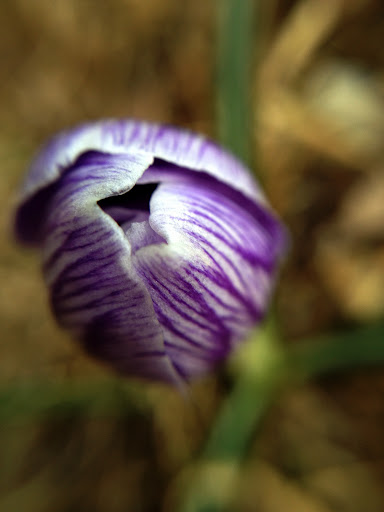
This is the first crocus that made it to the flowering stage in my yard this year. I type this with clenched teeth as I examine the neatly eaten stalks that signify a number of other crocuses may have bloomed already sometime when I wasn’t watching. Something is eating my flowers and I would like to find those crocus-eating creatures (probably a bunny, otherwise known as a hideous, evil, toothy demon) and explain that eating my flowers is not cute. NOT CUTE AT ALL. It results in that throbbing sensation on the right side of my temple. It makes me curse in horribly uncreative ways (you stupid, damn, stupid rabbit!). I want the crocuses to bloom and then experience a natural, withered death without meeting any teeth anywhere in their life cycle. You got that stupid stupid stupid damn bunny? I don’t care if you have a fluffy white tail that makes my last remaining cuteness neuron seize up with awe. Leave my crocuses alone!

First Crocus

This morning, flowers cracked open
the earth’s brown shell. Spring
leaves spilled everywhere
though winter’s stern hand
could come down again at any moment
to break the delicate yolk
of a new bloom.

The crocus don’t see this as they chatter
beneath a cheerful petal of spring sky.
They ignore the air’s brisk arm
as they peer at their fresh stems, step
on the leftover fragments
of old leaves.

When the night wind twists them to pieces,
they will die like this: laughing,
tossing their brilliant heads
in the bitter air.

© 2007 Christine Klocek-Lim

my review of "ten poems to say goodbye" by Roger Housden

ten poems to say goodbye
by Roger Housden
buy link

Several weeks ago a nice lady sent me an email asking if I’d like to review a new poetry book. “Free book? Awesome,” the little voice in my head said. A week later I received Roger Housden’s new book, ten poems to say goodbye. It’s a lovely hardcover: warm yellow background with a serene flower in a simple blue bowl beneath the title. I put it on my desk and there it sat while my life suddenly zoomed from leisurely to INSANE. I looked at it often. It seemed like such a pretty little book. I wanted to read it so badly, but I had no time.

Today I finally managed to open it, mostly because I have bronchitis and I can’t actually walk anywhere without getting out of breath. I couldn’t even get the mail without reaching for my inhaler. Yesterday I landed in the emergency room, chest tight, head spinning. Honestly, I wasn’t thinking about poetry. I was watching all the other people in the waiting room, most much sicker than I. When I opened Housden’s book today, I wasn’t expecting it to resonate so thoroughly. My hospital visit certainly contributed to my emotional suprise, but there was more to it than that—

This past weekend I helped clear out my mother-in-law’s apartment (she has multiple sclerosis and has had to move to a full-time care facility). It was strange packing up the mementoes of her life. She is an artist and some of the things we had to fold into boxes were her drawings and paintings. Some of it was old poetry. Some was just forgotten scraps of paper hidden in corners. Once the detritus was cleared away only the most luminous memories of what makes her her survived. My mother-in-law is doing okay, working hard with a physical therapist to keep herself strong, but oddly, the very beginning of the book made me think of her so forcibly I had to stop and just breathe for a moment. Housden’s introduction was like a cold draft of air that suddenly cleared away all the old leaves in my head and left me with his simple mantra: “great poetry reaches down into the depths of our humanity and captures the very essence of our experience.”

I’ve been writing poetry for decades. Critiquing, reviewing, and editing it for nearly as long. Strangely, I had forgotten what it is to be simply a reader. Housden’s book opens with one of the most straightforward explanations of why poetry matters and always will. Poetry captures humanity and “delivers it up in exactly the right words.” The introduction explains why he put this book together, a sort of mini-poetry-anthology. The book gives us ten poems to ponder. Each is accompanied by an essay where he considers the poem, explains why it is important to him, and why it has meaning for others. The poems detail the act of saying goodbye. Through our lives we say goodbye to people, things, and the more amorphous stuff of life. This book reminded me of why poetry is the essential tool of the mind and heart for doing so.

Some of the poems in the book are ones I know and some I’ve read often. “The Lost Hotels of Paris” by Jack Gilbert (I adore Gilbert’s poetry) and “How It Will Happen, When” by Dorianne Laux are two that I’ve seen before. Others were new to me: poems by Ellen Bass, Gerald Stern, Rilke, and more. For some of the poems Housden offers a short biography of the poet to explain to the reader how astonishing the poem truly is, especially as it relates to the poet’s life (he mentions Gilbert’s encroaching dementia to great effect). In others, he remarks on how well a particular poet writes the poetry of humanity. With every poem, however, Housden manages to illuminate the lines and words so that even the most novice reader will understand and appreciate what is happening. The act of reading the poem makes it real.

It’s been years since I’ve read poems like this. Oh, not poems of goodbye or realization or any of the usual human foibles, but rather, it’s been years since I’ve read poems with my writerly eyes stripped away. I try to consider the reader when I am writing, always and of course, but it’s been ages since I truly understood what it’s like to come to a piece of art, innocent and yearning. Housden somehow manages to capture that essence and give it back to you with his essays. He deciphers the poems without taking away from them. Instead he gifts them to the reader with a sort of step ladder that reaches to the top of those towers of words. The remarkable thing is that he does it without imposing himself onto the poem.

This brings me back to the beginning, when I consider what it’s been like to have to stop moving (literally) directly after spending a weekend moving someone else’s life into boxes. Housden said in the introduction, “. . . the fullness of life escapes us either way, whether we are holding on or pushing away. . .” I have had to both stop and say goodbye in the space of a week. My mother-in-law is even now struggling with the same idea. Housden insists that poetry can help us with this. “Well, yeah,” I think, paging through the book. Inevitably, I stop on page 46 and read the closing lines of Jack Gilbert’s poem:

“. . . We see the memory
of when they were, once upon a time.
And that too is more than enough.”

Housden’s delightful collection of ten poems, one for every kind of goodbye I can imagine, is definitely a book I would recommend. Both writers and readers will enjoy the gorgeous poetry, some of which I have read and loved for years (selections from Gilbert, Laux, Rilke, and others). Housden’s insightful thoughts about the poems illuminate the lines with a joy I didn’t expect in a book that documents the act of leaving and letting go. His essays and these ten poems reminded me that “. . . our life of the senses and feelings and thoughts, it all matters after all.” Especially when saying goodbye.

Ballroom — a love story

In honor of Valentine’s Day, I’m posting one of the poems from my new chapbook, Ballroom — a love story, forthcoming from Flutter Press.

Tango — torneo cinco

My mother finds me in the kitchen
with ice and bandages, foot propped
like a broken shoe.
My bruise looks like Argentina,
a forest of color.

We’re learning the tango, I say,
thinking of the trees outside
the dance studio. Oaks along the river.
My mother is thinking, how terrible
the leaves die each winter.

Sometimes love necessitates disaster.
She didn’t see his face when we came together.
How I dared him to fall as I stepped around him.
How he dared me to lead, fingers on my body
tight as a locked door. I took five steps,
unaware of the vertigo. The difficulty of toes
and muscle aligning. It’s easier to walk alone
but not as beautiful, I thought, then lost
my way. The forest is a trickster.

Doesn’t it hurt? she wonders, fingering my instep.
I bandage the pain and pull away.
No explanation.
I’m remembering the trees, how the leaves
turned scarlet at just the right moment.

His palm, perilously sweet
against my wound.

© 2012 Christine Klocek-Lim