Poem Spark July 17-24 – The "I" Point of View

Greetings fellow poets. I began thinking of the poem spark today after reading Alison Pelegrin’s poem “Three Prayers from the Broken-Hearted,” in the Summer 2006 issue of Rattle. In this poem there are three parts, all of which use the confessional “I”, and each of which is written from a different person’s perspective. The first part’s speaker, Earl, is the father of two (now grown) daughters. The introductory line of “I. Earl” reads: “In many failures have my daughters cried.” In the second part, “II. Cheryl”, one of the daughters speaks:

“The day he left my mother cut my hair—
. . .
She said I had to try
to be her little man because my daddy
went and had another little girl.”

In the last section, “III. Eunice”, the other daughter speaks:

“Mostly I’m in silence when the sadness comes,
imagining the woman I’d be if I were whole.
How can it be he kept us both apart?

In each of these sections the author writes writes convincingly and with authority from the point of view of three very different people. The only thing that unites the poem is the characters’ common sense of “broken-hearted”-ness. “How is this possible?” you may ask. If you were educated in the 20th century you are no doubt familiar with the work of Whitman, Ginsberg, and Plath, all of whom wrote many poems with the “I” firmly entrenched as the dominant point of view.

So, is every “I” point of view in a poem the poet speaking? Or is it a persona? Is the poem’s speaker a real person, or is it a character created by the poet? These are valid questions and can be used to further one’s understanding of a poem. Indeed, it is much easier to understand Dylan Thomas’ poem “Do not go gentle into that good night” if one understands that he suffered from alcoholism and a tendency toward flamboyance.

Yet, assuming that the narrator in the poem is the poet speaking is a dangerous misconception. After all, mystery novelists don’t need to be serial killers to portray one in their books. Does every poet need to be suicidal to convincingly write about angst? Here is a Poets.org essay written by Rachel Zucker which gives us a somewhat amusing take on the “I” in poetry: Confessionalography: A GNAT (Grossly Non-Academic Talk) on “I” in Poetry

Here are some examples of poems that use “I” as the point of view, but which are definitely characters, not the poet him/herself speaking:

John Berryman Dream Song 4

Claudia Emerson Bone

This week, write a poem that uses the “I” as the dominant point of view in the poem. The catch: “I” must be a character. If you are a woman, make your character male. If you are male, make your character female. If you are young, write from the point of view of an old person. You get the drift. Good luck and have fun!
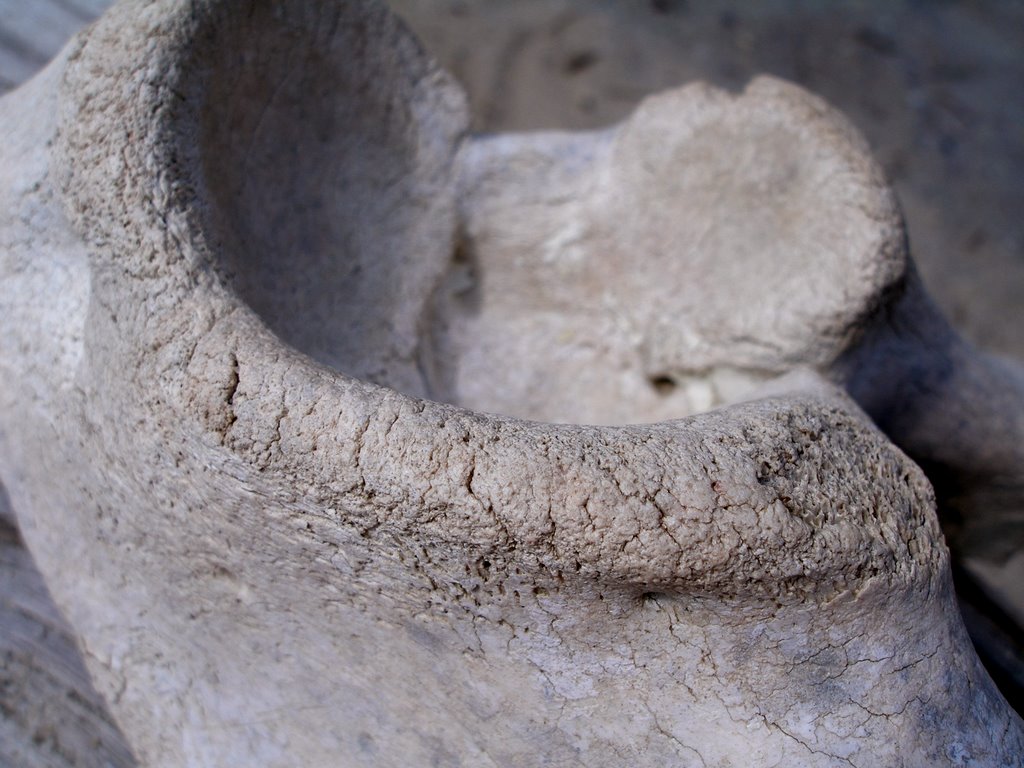
Bone


Bone

What is this bone, this seizure
of porous strength, this strange
scratch of leftover animal?
I found you in the sandbox
at the zoo, guttered rough
and disjoint from the whole
skeleton that is now nowhere
to be found. Children finger
the edges of your joint;
despite their innocence
they know that you are old
and missing pieces. Now
the sun sharpens its claws
on you. Now the empty
sand cradles your stark voice.
And when I toss you down
from my hands, your solitary
curve shadows the light
with secrets.

© 2006 Christine Klocek-Lim

After the flood


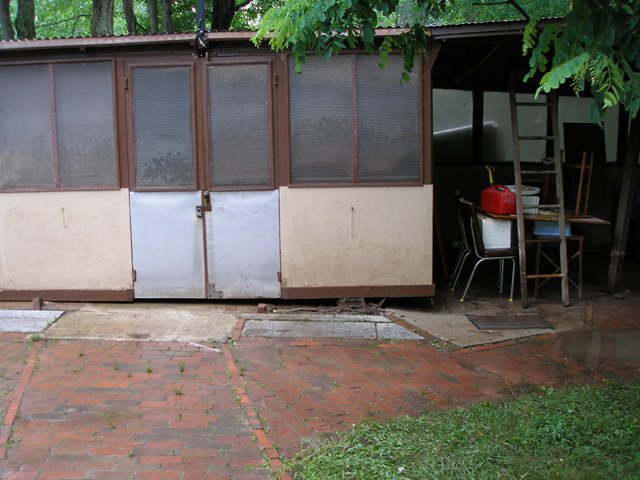
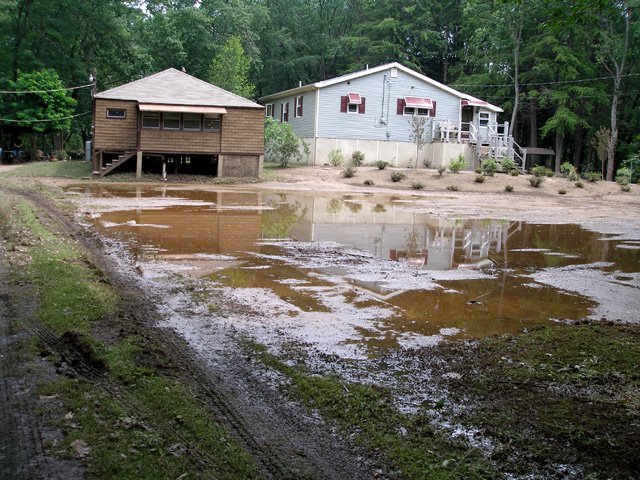
This is part of why I’ve been so scarce lately. My family’s cabin (the brown one) sits near the Nescopeck creek in Pennsylvania. The water came up to some windows, and above others.

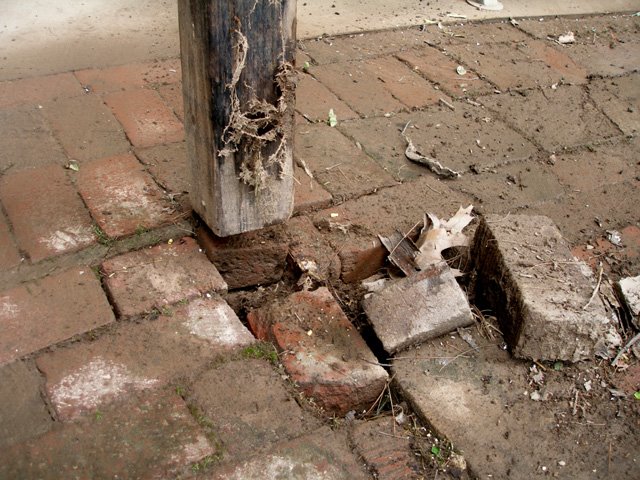
The water sucked the patio enclosure right out of its foundation, as you can see from the bottom of the support pole and broken bricks.

The water also decapitated the fireplace.

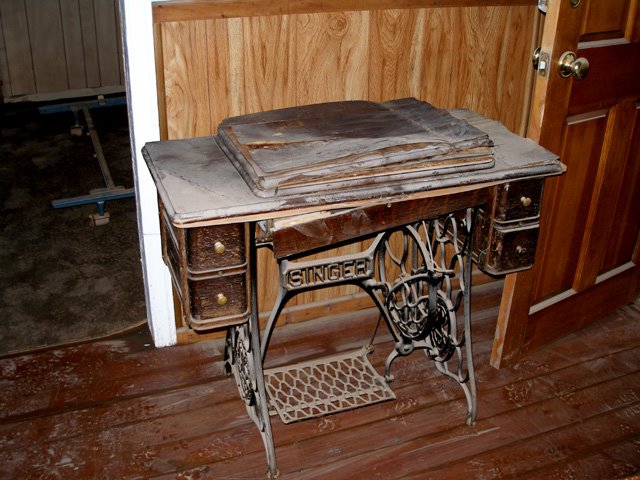
I’m not sure how many floods my grandmother’s sewing machine has been through, five or six maybe? This is the flood that finally killed it.

Chairs from the dining table. Yucko. The smell is what is really disgusting.

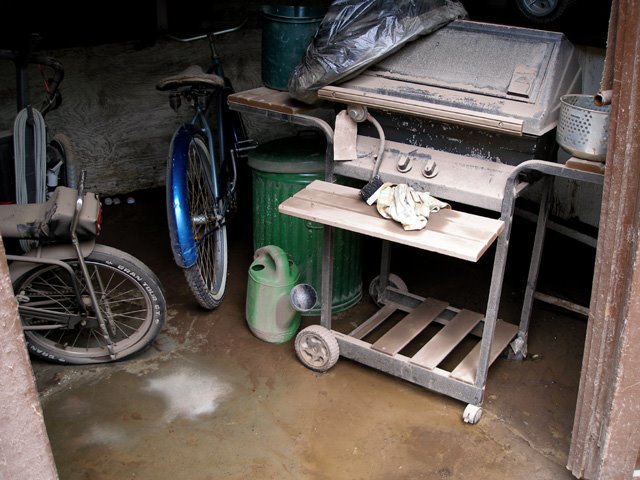
The gas grill is also dead. Like the toaster oven, the microwave, and the coffee maker.

Another photo of the patio pole, because I just can’t believe it actually came out of the foundation. In 50 years, this is the worst flood. Well, except for the one that happened in wintertime. When the water froze inside and every time we tried to clean the wash water also froze. And fell on us.

No more carpets. Ever again. My mother promised that she wouldn’t even try. The floors will be bare wood from now on. Nothing is more fun than carrying out flood-soaked carpets that leak stuff all over you. Who knows what kind of microbes are in there? Amoeba, protozoa, paramecium, etc.

The water even moved the enclosed portion of the patio three feet or so to the right. And it’s not actually touching the ground on the entire right side. It’s just floating. In the air.

This is what happens when you mix wash water with flood water. Yummy. Looks like a good, thick, chocolate milkshake. Well, except for the smell. Which I already mentioned.

How to say I love you

Because your magic hands
went soft years ago.

Because you slept through
tonight’s weather forecast
and lightning has just begun
to flash.

Because strands of hair cling
to your brush like antiseptic
threads that bind nothing.

Because I’ve shut the windows
and the deadened silence is chaotic.

Because the veins of your body,
vibrantly knotted for so long,
have disappeared beneath
the fragile parchment
of your skin.

Beacause the power will flicker soon,
and fail, stranding me here
with the bewildered sound
of thunder.

© 2006 Christine Klocek-Lim

Poem Spark June 26-July 3 – Weather Poems

Salutations fellow poets!

I’ve been thinking a lot about the weather these past few days, probably because I’ve woken up to the sound of rain drumming my roof every night for a week. Right now it’s windy and pouring again; the air is grey with the falling water outside my window. The trees are bowing low and a new crop of mushrooms has appeared. It’s time to write a poem about the weather.

Poets have a long tradition of writing about the natural world. Just last year the number of poems about Hurricane Katrina was incredible and I’m sure there have been other weather-disasters that have sparked poems. But there is also the joyful element of the weather which poems can celebrate: the rain after a long drought, the excitement of a blizzard, the tremendous heat of the desert. Here are some examples of weather poems:

John Berryman Dream Song 8

Louise Glück October (section I)

Ted Kooser Porch Swing in September

Emily Brontë Spellbound

This week’s spark: write a weather poem. It can be about the tornado you saw on TV, the winter storm that tore down the gutters, the flood that snatched your neighbor’s cat from the tree in your backyard. Be creative! Write a poem that celebrates the wind or grieves the loss of what has happened in a storm’s wake. Good luck!

Poem Spark June 19-26 – Ars Poetica

Salutations fellow poets!

This week I wanted to talk a little about our new Poet Laureate: Donald Hall. So I pulled down a few books from my collection and began randomly searching for poems by Hall and/or conversations with him. I came across his intriguing interpretation of his poem, “Ox Cart Man,” in the book “What Will Suffice – Contemporary American Poets on the Art of Poetry,” edited by Christopher Buckley and Christopher Merrill:

Donald Hall wrote:
Every poem suggests an Ars Poetica. In the 1960s I wrote something called “The Poem,” then late in the 1980s another called “This Poem.” In between, I wrote “Ox Cart Man” in which (as I worked on it) I had no notice that I addressed the poet’s purpose or task. I wrote an ars poetica anyhow. The ox-cart man’s endless labor makes a cycle like a perennial plant’s; writing the poem, I exulted in his annual rite of accumulation and dispersal. Not until I finished it, published it aloud and in print, did I become aware of a response that astonished me: Some people found it depressing: all that work, and then he has to start over again. . . . Later, a friend compared the ox-cart man’s story to a poet making a poem—and when I heard the notion, it rang true. For decades I have known that you must bring everything to a poem that you can possibly bring: Never hold anything back; spend everything at once—or you will never write a poem. . .

This is interesting, I thought, because on my search for the text of the “Ox Cart Man” I ran across this wonderful page that shows us the nineteen revisions his poem went through and three different published versions. The art of poetry is work that is endless: just when you think you’ve got it perfectly written, you come back to it months and even years later to find a revision lurking between the lines.

So what is an ars poetica? Simply put, it is a poem about writing a poem. Of course, nothing is ever as simple as it first appears and the same is true when trying to define the idea of ars poetica. Poets have been speaking about poetry for thousands of years: from Horace to the present. As always, I feel the best way to learn is through example. So here are a few “ars poetica” for your perusal:

Donald Hall Ox Cart Man

Archibald MacLeish Ars Poetica

Czeslaw Milosz Ars Poetica?

Dana Levin Ars Poetica (cocoons)

This week’s spark: write an ars poetica. Use any style, any form, any words you like. Be creative and have fun!

What we know about poverty

This was written for the poem spark of last week: the Political Poem.

What we know about poverty

On the street
the mouth of the world
asks: whose mother is this?
Whose baited hook tore
the smile from her cold cheek?
Crows fly above the invisible
hands of the sidewalk (cracked
in mourning). The country’s lips
are pursed. The difficult breaths
of the people blow like scattered leaves.
There are tears. Missing books and no water.
The burden of so many locked doors keeps
the tongues still. The skill of learning has been taken,
removed, amputated until there is no belonging in this place,
no where to rest but in the cramped shoulders of the buildings.
No one claims the mother’s body. No one staunches the blood
though the crows keep flying like madmen in the sunken cheeks
of the sky.

© 2006 Christine Klocek-Lim