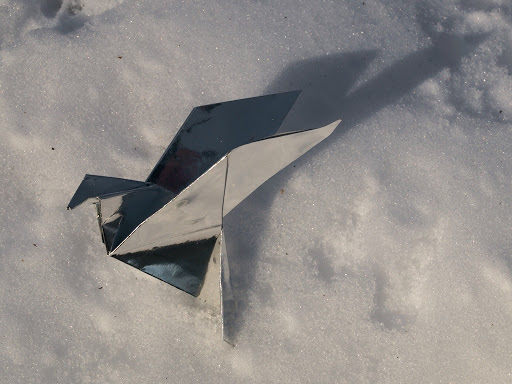
first snow so quiet
you can hear the doves flutter
their wingtips and leap
© 2009 Christine Klocek-Lim
first snow so quiet
you can hear the doves flutter
their wingtips and leap
© 2009 Christine Klocek-Lim
I’ve been a mother for nearly fifteen years. I still remember the first shocking moment that I realized what I’d done, and no, it wasn’t in the hospital or even when I brought the kid home. It wasn’t even that night. It happened a few days later when he suddenly stopped staring adorably out at the world and began screaming non-stop for the next ten months. Well. Right then I learned my lesson: your child is not an extension of you. This small, helpless infant was his own person. Sure, his dad and I fed him and hugged him and made sure he didn’t die from lack of sunlight, but still, none of that is actually the point, is it? Really, the fact that I kept him and his younger brother alive for all these years isn’t the point either, even though I am justifiably proud of it since even now I can’t keep a plant green for longer than a year or so.
Now, I suppose I ought to get all sentimental and explain to my own mother (who will hopefully read this) how much she means to me and how grateful I am to her for feeding me and keeping me alive long enough to talk back at her and slam doors and all the other repellent teen stuff, but you know what? She already knows. Instead, I’d like to explain what I really think motherhood encompasses: the job is to teach your child how to ask questions. Really, it’s not anything more complicated than that. The truth is, the ability to survive has always depended on how good you are at solving problems. That used to mean understanding about winter and how to store food and learning enough about being charming to secure your status in the tribe. These things are still important, but one problem that seems to loom in our culture even larger than the issue of mere survival these days is how can I be happy? The funny thing? You can’t teach your kid how to be happy unless you’ve figured it out first. By the time you do figure it out, if ever, you have learned that teaching happiness is impossible (which, damnit, was a really aggravating discovery). You can only show them how to ask the questions that they find important, because remember, your kids are not you and what makes you happy will not necessarily make them happy. The trick is to teach them how to find their own answers. The other trick is to let them ask their own questions.
I wrote a poem a few years ago called, “The book of small treasures.” It’s the title poem from my unpublished chapbook in which all the poems are about motherhood:
The book of small treasures
Each day, he holds out his empty book,
the pages filled with blankness as if to ask:
so, now what? I have no answers. I am
a mother. Philosophy reveals itself slowly,
if at all, in the small things: a dark tree
suddenly clear in the fog, a tadpole
moving ecstatically in the roadside puddle.
I teach him to fold these little treasures
in his book, to save them forever, and he does
what I ask, mindlessly, but it is still not enough.
He needs more answers to fill up the landscape
he’s just discovered. He needs both love
and distance, like the garden that won’t bloom
until you step away. This is what I write
in my book, slowly, with much prodding
and resistance. These are the things my mother
taught me when I was a girl, when she let me hold
her book, its pages filled with thin drawings,
penciled resignation. The blankness punctuated
with the occasional, brilliant letter.
Ultimately, I think the question of how to be happy is really not a question so much as it is a walk somewhere. Along the way it’s helpful to note which things in life bring you joy. In the true perverseness that is life, they’re never what you expect and certainly not anything to do with “success” or “what you’re supposed to do.” Often, the stuff that really makes me happy are the things that take the most work, like learning how to write, drinking a perfect cup of tea (you would not believe how long it took me to get the temperature right), or finally realizing that every person I love isn’t perfect and forgiving them and myself for having expected the impossible. I could go on, but my explanations would be meaningless since every person’s happiness is, well, personal. This is the thing I want my boys to learn. This is what I’m teaching them when I ask: what are your questions? Go find them and don’t worry if you don’t figure it out right away. Life may often suck, but it’s cool, too. You get to try things more than once.
Some of this I learned on my own. Some of it I learned from my mother who stubbornly continues to listen to me, despite my insistent departure from her most familiar philosophies. That can’t be comfortable for her and I am always amazed when she tells me she has learned something from me. I want to be that kind of mother, the one who listens to her kids and respects their discoveries about happiness. Maybe it was her insistence that “contentment is boring” that made me ask and ask and read and move out and live completely differently than anyone else in the family that convinced me that the question is the answer. Whatever the case, I wouldn’t have managed it if she hadn’t had the fortitude to let me be my own person. Today I filled in some more pages of that blank book she gave me when I was born (hey, I’m speaking metaphorically here, don’t expect a photo, sheesh). This morning I wrote: Hey Mom? Thanks for the book.
.
Tony Williams: DREAMING OF YOUR LOVE (KOFT video contest WINNER!!!) from MABONA ORIGAMI on Vimeo.
Peace
Wisdom becomes you
the paper crane says,
flaps its origami wings.
You have just finished folding it,
hands poised in midair
when again the words come out,
rustle the tiny beak like a leaf
on water.
You clutch the neck and feet,
think: oh delicate
this bird could break so easy.
The creases tickle your palms
as you smooth the paper.
Watch the baited hook
it speaks again
and you look around
like a folded puppet,
like you were really a fish
caught in water at Hiroshima.
But even a thousand cranes
cannot change history
so you squeeze the paper,
check for blood.
Carefully the wings fold down,
the legs retract.
The beak closes, holds its breath
until you look again:
an eye tiny as a speck
peers up.
This is no dancing crane
you muse quietly to yourself.
The crane speaks no more
as you tuck it onto a windowsill.
You leave it there for many years,
afraid it might speak again,
afraid it might not.
© 2004 Christine Klocek-Lim
.
removed
.
.
removed
.
.
removed
.
.
removed
.
.
removed
.
 Christine Klocek-Lim