
— a poetry interview series by Christine Klocek-Lim

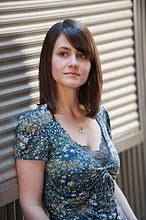
Donna Vorreyer
(contributing writer at Voice Alpha)
1. What is your favorite poem that you’ve written? Read?
Written? I don’t have a favorite – that’s like choosing a favorite child. I will say that I am usually most proud of my more current poems than of older ones. I am especially fond of a series of poems I wrote last summer that were inspird by the letters of Elizabeth Bishop and Robert Lowell. They are starting to find homes – “Digging In” was featured on Linebreak earlier this year.
Read? I have a short list: “Forgotten Dialect of the Heart” by Jack Gilbert is at the top of the list, as well as “Coliseum” by Katie Ford, “At the Fishhouses” by Elizabeth Bishop, and pretty much anything by Whitman.
2. Do you think there is a disconnect between academic poets/poetry and online poets/poetry?
There shouldn’t be. But, unfortunately, I often think that there is. There can be an element of clique to those who are working/writing in academia – a “we-are-hipper-and-way-smarter-than-you” vibe that I can do without. (I see enough of that teaching 13-year-olds every day.) The community of poets in Chicago is so gloriously open and diverse that I don’t often experience this disconnect in my personal interactions with other local poets. However, I did attend my first AWP this year, and I definitely felt it there. I even had someone (who I don’t know, by the way) question why I was “bothering” to attend since I was “only a middle school teacher” and not interested in getting an MFA. So, the fact that I am active in the poetry community and have been fairly widely published and take my writing seriously seems unimportant to some. I choose to ignore those people and spend time with those, academic or not, who welcome me as a member of their word tribe.
3. Has the rise of the poetry MFA been positive or detrimental to the art?
As a teacher, it would be difficult for me to say that anything that gets people writing is detrimental to the art. I have heard others say that some MFA programs seem to be “degree mills” that don’t give honest feedback to writers who may need to be pushed to achieve quality work, but having no experience with an MFA, I’m not sure if it’s true. I’m sure that every program is different. I have some friends who highly value what they have learned in their MFA programs, and others who have dropped programs or felt them a waste of money. It certainly widens the pool of competition for publication, but that’s not necessarily a bad thing.
4. Do you write for yourself or for an audience/reader?
I write first for myself. But after a draft is born, it usually is revised with a reader in mind. If it only makes sense to me, it does not function as a means of communication, which I think a poem should do. The act of writing is an intimate and personal act. Once you decide to share that writing with the world, considering the reader is important. In the end, all poems are written for me in the sense that they teach me something about myself, about the way I see the world.
5. How much of what you write is inspiration vs. perspiration?
I draft pretty quickly, and I often use free writing and exercises to get started. The majority of my process is the perspiration part. I spend quite a bit of time revising before I show a new piece to anyone except a couple of trusted poet friends. I don’t wait until I am inspired to write, or I would never get any writing done. Free writing has been a wonderful way to get me writing nearly every day without worrying so much about the initial product.
6. How has the way you write changed (or not changed) over time?
I used to draft, fiddle a little, and send my poems out into the world LONG before they were finished. I am more patient now, working over each line and word choice until I feel that they couldn’t be any other way. Then I put them away and wait awhile before looking at them again. Patience was a difficult thing for me to learn as a writer as I often am smitten with new things that I create. Learning to be more objective and wait has been the biggest change for me over time.
Bio:
Donna Vorreyer has traveled with her family to every continent except Antarctica and boasts an impressive collection of memories, including an excellent scar from a mountain bike crash in the Himalayas. Her poetry has appeared or is forthcoming in numerous journals including Cider Press Review, New York Quarterly, qarrtsiluni, and Rhino. Her chapbooks include: Ordering the Hours (Maverick Duck Press, Come Out, Virginia (Naked Mannekin Press), and Womb/Seed/Fruit (Finishing Line Press). Her website is: www.donnavorreyer.com and her blog is: djvorreyer.wordpress.com.
~~~~~~~~~~~~~~~~
Couplets: a multi-author poetry blog tour – click for a list of participating blogs and daily entries
Upper Rubber Boot Books is coordinating a book blog tour for April, to help promote poetry and poets for National Poetry Month. Check back here for updates throughout the month of April (we’ll also post updates to our blog, and so will many of the participating poets).

~~~~~~~~~~~~~~~~






 Christine Klocek-Lim