- 1 April 2012: what we make waiting for death (Lyn Lifshin at Joanne Merriam).
- 1 April 2012: National Poetry Month: Guest Post #1, Stella Pierides . . . (at Margaret Dornaus’ Haiku-doodle)
- 1 April 2012: Inquiring Minds and Other Clichés – Neil Aitken (at Christine Klocek-Lim’s November Sky Poetry).
- 1 April 2012: National Poetry Month: Margaret Dornaus (at Stella Pierides: Literature, Art, Culture, Society).
- 1 April 2012: Gillena Cox (at Angie Werren’s feathers: micropoetry (and tinyprose)).
- 1 April 2012: Kristine Ong Muslim on Arlene Ang’s “Living Without Water” (guest post) (at Peg Duthie’s zirconium).
- 2 April 2012: National Poetry Month: Guest Post #2, Jenny Ward Angyal . . . (at Margaret Dornaus’ Haiku-doodle)
- 2 April 2012: Margaret Dornaus (at Angie Werren’s feathers: micropoetry (and tinyprose)).
- 3 April 2012: National Poetry Month: Guest Post #3, Cara Holman . . . (at Margaret Dornaus'< a href=”http://haikudoodle.wordpress.com”>Haiku-doodle)
- 3 April 2012: Translation in poetry: thorny problems — a guest post by Sue Burke (at Heather Kamins: fiction, poetry, and other necessities)
- 3 April 2012: Inquiring Minds and Other Clichés – Hannah Stephenson (at Christine Klocek-Lim’s November Sky Poetry).
- 3 April 2012: Couplets: a multi-author poetry blog tour — Marty Smith (at Shiteki Na Usagi [T.A. Smith/Yousei Hime])
- 3 April 2012: Yousei Hime (at Angie Werren’s feathers: micropoetry (and tinyprose)).
- 3 April 2012: how will we translate ourselves? (Deirdre Dwyer at Joanne Merriam).
- 4 April 2012: Couplets Blog Tour: Carol Berg Hosts Peg Duthie (at Ophelia Unraveling)
- 4 April 2012: National Poetry Month: Guest Post #4, Christina Nguyen (at Margaret Dornaus'< a href=”http://haikudoodle.wordpress.com”>Haiku-doodle)
- 4 April 2012: Start with a number . . . (Sonja deVries, Yael Flusberg, Janine Harrison, Jaime Lee Jarvis, and Margaret Rozga at JoAnne Growney’s Intersections –Poetry with Mathematics)
- 4 April 2012: Featured “Couplets” Poet: Margaret Dornaus (at Christina Nguyen’s< a href=”http://tina.mnnguyen.com/”>A wish for the sky…)
- 4 April 2012: Christina Nguyen (at Angie Werren’s feathers: micropoetry (and tinyprose))
- 5 April 2012: Poetry of the Urban Pastoral (Celia Lisset Alvarez at Scattered Showers in a Clear Sky: Poetry, Gardening, Birding, and other reflections on life [Anne Higgins])
- 5 April 2012: National Poetry Month: Guest Post #5, Kirsten Cliff . . . (at Margaret Dornaus'< a href=”http://haikudoodle.wordpress.com”>Haiku-doodle)
- 5 April 2012: Inquiring Minds and Other Clichés — S. Abbas Raza (at Christine Klocek-Lim’s November Sky Poetry).
- 5 April 2012: National Poetry Month: Lisa J. Cihlar (at Stella Pierides: Literature, Art, Culture, Society).
- 5 April 2012: Marty Smith (at Angie Werren’s feathers: micropoetry (and tinyprose))
- 5 April 2012: writing is my excuse for being myself (Jenniey Tallman at< a href=”http://www.joannemerriam.com/”>Joanne Merriam).
- 6 April 2012: Stella Pierides (at Angie Werren’s feathers: micropoetry (and tinyprose))
- 6 April 2012: Don’t Wait (Carol Berg at Mary Alexandra Agner)
- 7 April 2012: “Books teach me to attend to this world” — a guest post by Lynn Domina (at Heather Kamins: fiction, poetry, and other necessities)
- 7 April 2012: Inquiring Minds and Other Clichés — Ayesha Chatterjee (at Christine Klocek-Lim’s November Sky Poetry)
- 7 April 2012: Deb Scott (at Angie Werren’s feathers: micropoetry (and tinyprose))
- 7 April 2012: The poem itself should tell the reader the melody of itself by way of its combination of words. (Jericho Brown [autoplays music] at Joanne Merriam)
- 7 April 2012: Introducing Community Activist/Poet/Playwright Bryan Thao Worra (at Wendy’s Muse [Wendy Brown-Baez])
Author Archives: Christine Klocek-Lim
Inquiring Minds and Other Clichés — O.P.W. Fredericks
— a poetry interview series by Christine Klocek-Lim

Inquiring Minds and Other Clichés — Ayesha Chatterjee
— a poetry interview series by Christine Klocek-Lim
Ayesha Chatterjee
1. What is your favorite poem that you’ve written? Read?
One of my all-time favourite poems is Tennyson’s Ulysses. It was an anthem for me when I was growing up. At the moment, of my own poems, the one that seems least flawed to me is The Last Generation from The Clarity of Distance.
2. Do you write for yourself or for an audience/reader?
I write for myself as an audience, as though I were reading someone else’s work.
3. How much of what you write is inspiration vs. perspiration?
It’s very hard to say. Possibly equal amounts. And sometimes it’s the inspiration that comes first, sometimes it’s a lot of perspiration.
4. If you were a Celtic bard, carrying poems from place to place as if they were the last flame, which ones would you sing?
Emily Dickinson’s I taste a liquor never brewed
Ranjit Hoskote’s The surveyor’s complaint
Thomas Hardy’s The Voice
Jo Shapcott’s Thetis
Kamala Das’ The Dance of the Eunuchs
5. Why do you read or write poetry?
It’s how I make sense of the world. It’s like art and music and philosophy all rolled into one. I read it for the sounds and images and because it surprises me. Because I can and do memorize it and then I carry it around like photographs.
6. How has the way you write changed (or not changed) over time?
I’ve learned to trust myself more as I’ve developed my own voice. It’s like swimming, you let go of the floats as you gain confidence.
Bio:
Born and raised in Kolkata, India, Ayesha Chatterjee has lived in England, the USA, Germany, and currently resides in Toronto. Her work gained notice when one of her poems was shortlisted in the Guardian Unlimited Poetry Workshop in October 2004.
Her poetry has appeared in nthposition, Autumn Sky Poetry, and BluSlate. In 2010, she read at the Poetry with Prakriti Festival in Chennai, India. This October, she will be reading at the International Festival of Authors in Toronto.
Her first poetry collection, The Clarity of Distance, is a meditation on the complexity of existence and the search for moments of truth within it.
Book Details:
The Clarity of Distance at Bayeux Arts
The Clarity of Distance at Barnes & Noble

Inquiring Minds and Other Clichés — S. Abbas Raza
S. Abbas Raza
(Founding Editor of 3 Quarks Daily)
1. What is your favorite poem that you’ve written? Read?
“Learning By Heart” and much as I would like to pretend to be more erudite than I am by choosing something a little more obscure for my favorite of all poems I have read, I’m going to be honest and go with “Thirteen Ways of Looking at a Blackbird” by Wallace Stevens.
2. Do you think there is a disconnect between academic poets/poetry and online poets/poetry?
I have no idea.
3. Has the rise of the poetry MFA been positive or detrimental to the art?
I have no idea.
4. Do you write for yourself or for an audience/reader?
For an audience, sometimes a specific reader.
5. How much of what you write is inspiration vs. perspiration?
Mostly inspiration for me, which is why I write so seldom. For example, the imagery of the last stanza in the poem I have given above as my favorite of any I have written came to me in a dream (a faceless man dressed in a dark suit was explained to be the evening itself by a friend in the dream, who then went on to suggest we put a bright tie on him). The rest of the poem was worked backwards from there.
6. Bonus question! Answer any one of the following:
a. Do you ever include the works of others in your readings? If not, why not? If so, who and why?
I’ve never done a reading.
b. If you were a Celtic bard, carrying poems from place to place as if they were the last flame, which ones would you sing?
Waiting for the Barbarians by Cavafy.
c. Why do you read or write poetry?
For fun and also sometimes to impress girls.
d. How has the way you write changed (or not changed) over time?
It hasn’t.
e. What did you have for breakfast this morning?
A Coke Zero, which is my breakfast everyday.
f. Anything else you’d like to say?
Christine, I’ll add this: I have written MANY, MANY poems over the years for friends and family to commemorate special occasions like weddings (at one point I was in some demand as a wedding poet!), birthdays, graduations, etc. These are, obviously, not literary efforts. They talk about the specific people present and tend to be funny and are usually quite crowd-pleasing! I wish more people would put poetry to such less-serious uses and stop trying to be so damn profound!

Entries
- 4 April 2012: Couplets Blog Tour: Carol Berg Hosts Peg Duthie (at Ophelia Unraveling)
- 4 April 2012: Christina Nguyen (at Angie Werren’s feathers: micropoetry (and tinyprose))
- 4 April 2012: National Poetry Month: Guest Post #4, Christina Nguyen(at Margaret Dornaus’ Haiku-doodle)
- 4 April 2012: Featured “Couplets” Poet: Margaret Dornaus (at Christina Nguyen’s A wish for the sky…)
- 4 April 2012: Start with a number . . . (Sonja deVries, Yael Flusberg, Janine Harrison, Jaime Lee Jarvis, and Margaret Rozga at JoAnne Growney’s Intersections — Poetry with Mathematics)
- 3 April 2012: Couplets: a multi-author poetry blog tour — Marty Smith(at Shiteki Na Usagi [T.A. Smith/Yousei Hime])
- 3 April 2012: Translation in poetry: thorny problems — a guest post by Sue Burke (at Heather Kamins: fiction, poetry, and other necessities)
- 3 April 2012: Yousei Hime (at Angie Werren’s feathers: micropoetry (and tinyprose)).
- 3 April 2012: National Poetry Month: Guest Post #3, Cara Holman . . .(at Margaret Dornaus’ Haiku-doodle)
- 3 April 2012: how will we translate ourselves? (Deirdre Dwyer at Joanne Merriam).
- 3 April 2012: Inquiring Minds and Other Clichés – Hannah Stephenson(at Christine Klocek-Lim’s November Sky Poetry).
- 2 April 2012: National Poetry Month: Guest Post #2, Jenny Ward Angyal . . . (at Margaret Dornaus’ Haiku-doodle)
- 2 April 2012: Margaret Dornaus (at Angie Werren’s feathers: micropoetry (and tinyprose)).
- 1 April 2012: Kristine Ong Muslim on Arlene Ang’s “Living Without Water” (guest post) (at Peg Duthie’s zirconium).
- 1 April 2012: Gillena Cox (at Angie Werren’s feathers: micropoetry (and tinyprose)).
- 1 April 2012: Inquiring Minds and Other Clichés – Neil Aitken (at Christine Klocek-Lim’s November Sky Poetry).
- 1 April 2012: National Poetry Month: Guest Post #1, Stella Pierides . . .(at Margaret Dornaus’ Haiku-doodle)
- 1 April 2012: National Poetry Month: Margaret Dornaus (at Stella Pierides: Literature, Art, Culture, Society).
- 1 April 2012: what we make waiting for death (Lyn Lifshin at Joanne Merriam).
Blogroll
- A wish for the sky… (Christina Nguyen)
- Caught In The Stream (Francis Scudellari)
- feathers: micropoetry (and tinyprose) by angie werren
- Finding Your Voice (Michele Fischer)
- Haiku-doodle: a haiku journal by margaret dornaus
- Heather Kamins: fiction, poetry, and other necessities
- Intersections — Poetry with Mathematics (JoAnne Growney)
- Joanne Merriam
- Kristine Ong Muslim
- Mary Alexandra Agner
- Miriam’s Well: Poetry, Land Art, and Beyond (Miriam Sagan)
- Mount Orégano (Sue Burke)
- November Sky Poetry (Christine Klocek-Lim: also see her updates at thepoets.org forums)
- Old Fart Rambles (Steve Vernon)
- Ophelia Unraveling (Carol Berg)
- Poet 2.0 (Iris Jamahl Dunkle)
- Sabra Wineteer: writing in bloom
- Scattered Showers in a Clear Sky: Poetry, Gardening, Birding, and other reflections on life (Anne Higgins)
- Sherry Chandler
- Shiteki Na Usagi (T.A. Smith/Yousei Hime)
- Stella Pierides: Literature, Art, Culture, Society
- Sunslick Starfish: chronicling the amazing ideas and adventures of Ching-In Chen: Writer & Community Organizer
- Wendy’s Muse (Wendy Brown-Baez)
- What I Meant to Say (Wendy Babiak)
- The Wordsmith’s Forge: The Writing & Other Projects of Elizabeth Barrette (coordinating post)
- Writing with Celia (Celia Lisset Alvarez)
- zirconium (Peg Duthie)
Inquiring Minds and Other Clichés – Hannah Stephenson
— a poetry interview series by Christine Klocek-Lim
Maybe other poets will agree with me about their own work—my favorite of my own changes often. Recently, I’ve been happy with “Fraction” (because it was inspired by a tweet from Jimmy Kimmel!). When I read my work aloud, I like to read some of the longer, weirder ones (for instance, there is one called “Suddenly, Pasta Salad”). My favorite poem of all-time is Robert Creeley’s “The Language.”
2. Do you write for yourself or for an audience/reader?
I am definitely writing TO someone (not sure if that is the same thing as FOR someone). I am always speaking to my reader. Blogging my poems has helped me locate my reader. I don’t mean this literally, necessarily. But I do mean that I imagine sitting across a small table with someone, speaking to them pretty intensely and closely. That person is always shifting. Sometimes they are blurry, a collage of a few people (I think of how faces look blurred out on TV to protect identities), but sometimes they are clear. I am writing because I have something to say to my reader. And I really care about them/you.
3. How much of what you write is inspiration vs. perspiration?
I am a firm believer in making my own inspiration happen. And most of the time, inspiration is tough work! Moments of magical and sparkly inspiration occur very rarely (but they do happen). It’s because of the work that we can be ready for them. A beautiful moment of clarity can happen to us, so we better keep our beautiful-moment-of-clarity-muscles limber.
4. Do you ever include the works of others in your readings? If not, why not? If so, who and why?
Oh, yes! I absolutely love reading work by other writers. Recently, I’ve shared works by Carol Ann Duffy, Zachary Schomburg, and Bob Hicok. It’s so fun to be able to focus on sharing the words of others. I like opening readings with poems by others because it clearly defines the purpose of the reading—we’re here to take delight in words!—and it can remove some of the anxiety and self-consciousness we sometimes feel while reading.
5. How has the way you write changed (or not changed) over time?
I found some poems I wrote when I was 16. They are embarrassing, but I still see pieces of myself in them. At that age, I would describe my voice as GIDDY-OVERJOYED-THE-WORLD-IS-WONDERFUL!!! When I wrote poems six or seven years ago, or even at the beginning of The Storialist (in 2008), my voice sounds tentative and unfocused (but excited because I’d realized poems didn’t have to be about me). I remember asking myself, “Is this a poem? How do I know if it’s a poem?” Now, my voice sounds much stronger in my head, and I give myself permission to write whatever I’d like, however I’d like. It’s my poem, and I’ll write how I want to (you know, like that Lesley Gore song!). Now, my poems are sprinkled up and down the giddiness spectrum (with ENTHUSIASTIC RAPTURE! on one end, and ONE DAY THE WORLD WILL END, AND THAT IS OK on the other.).
6. What did you have for breakfast this morning?
Endless coffee. And a Luna bar (I teach an 8 AM class…no time to be fancy during the week). But on the weekend, an omelet with tomato, mushroom, spinach, and cheddar cheese. And many baked goods have distinctly breakfast-like qualities (if there’s oatmeal in it, or cinnamon, or bananas, or berries, or if it can be dipped in coffee) that allow me to think of them as wholesome breakfast options.

Entries
- 2 April 2012: National Poetry Month: Guest Post #2, Jenny Ward Angyal . . . (at Margaret Dornaus’ Haiku-doodle)
- 2 April 2012: Margaret Dornaus (at Angie Werren’s feathers: micropoetry (and tinyprose)).
- 1 April 2012: Kristine Ong Muslim on Arlene Ang’s “Living Without Water” (guest post) (at Peg Duthie’s zirconium).
- 1 April 2012: Gillena Cox (at Angie Werren’s feathers: micropoetry (and tinyprose)).
- 1 April 2012: Inquiring Minds and Other Clichés – Neil Aitken (at Christine Klocek-Lim’s November Sky Poetry).
- 1 April 2012: National Poetry Month: Guest Post #1, Stella Pierides . . .(at Margaret Dornaus’ Haiku-doodle)
- 1 April 2012: National Poetry Month: Margaret Dornaus (at Stella Pierides: Literature, Art, Culture, Society).
- 1 April 2012: what we make waiting for death (Lyn Lifshin at Joanne Merriam).
Blogroll
- A wish for the sky… (Christina Nguyen)
- Caught In The Stream (Francis Scudellari)
- feathers: micropoetry (and tinyprose) by angie werren
- Haiku-doodle: a haiku journal by margaret dornaus
- Heather Kamins: fiction, poetry, and other necessities
- Intersections — Poetry with Mathematics (JoAnne Growney)
- Joanne Merriam
- Kristine Ong Muslim
- Mary Alexandra Agner
- Miriam’s Well: Poetry, Land Art, and Beyond (Miriam Sagan)
- Mount Orégano (Sue Burke)
- November Sky Poetry (Christine Klocek-Lim: also see her updates at thepoets.org forums)
- Old Fart Rambles (Steve Vernon)
- Ophelia Unraveling (Carol Berg)
- Poet 2.0 (Iris Jamahl Dunkle)
- Sabra Wineteer: writing in bloom
- Scattered Showers in a Clear Sky: Poetry, Gardening, Birding, and other reflections on life (Anne Higgins)
- Sherry Chandler
- Shiteki Na Usagi (T.A. Smith/Yousei Hime)
- Stella Pierides: Literature, Art, Culture, Society
- Sunslick Starfish: chronicling the amazing ideas and adventures of Ching-In Chen: Writer & Community Organizer
- Wendy’s Muse (Wendy Brown-Baez)
- What I Meant to Say (Wendy Babiak)
- The Wordsmith’s Forge: The Writing & Other Projects of Elizabeth Barrette (coordinating post)
- Writing with Celia (Celia Lisset Alvarez)
- zirconium (Peg Duthie)
Inquiring Minds and Other Clichés – Neil Aitken
Neil Aitken
1. What is your favorite poem that you’ve written? Read?
Usually I’m most attached to the poem I’ve most recently written, which at the moment would be “Babbage Descending into Mt. Vesuvius, 1828.” Part of a series revolving around the life and experiences of Charles Babbage, 19th century mathematician, philosopher, and inventor of the Difference and Analytical Engines (designed, but never completed mechanical precursors to the modern computer), this particular poem focuses on the year following his wife’s early death, when he traveled to continental Europe and became obsessed with volcanoes, even going so far as to have himself lowered into Mt. Vesuvius and conducting a survey of the inside of the main crater. Although I’d done the research for the poem several months ago, it wasn’t until recently that the elements came together and the poem really took shape. I find the juxtaposition of Babbage’s personal grief and his reckless obsession with volcanic activity strangely compelling, at once speaking to his personal dedication to learning how things worked, and simultaneously exposing some darker impulse to take these life-threatening risks in the aftermath of a year that saw the loss of his beloved wife, his estranged father, and two of his children.
My favorite poem by someone else is Philip Levine’s “My Father With Cigarette, Twelve Years Before the Nazis Could Break His Heart.” I love this poem — the way it assembles a reality out of an accumulation of seemingly meaningless details, how it twists and turns, opening itself up to the reader, constructing the scene in memory as if it were a stage play, and how in the end the most powerful elements of the poem are those that have been the most silent.
2. Do you think there is a disconnect between academic poets/poetry and online poets/poetry?
Not really. In many ways I feel like this question assumes a false dichotomy — while the field of contemporary poetry is fairly diverse and complex (and sometimes fractured), I find that the divisions aren’t usually along the lines of “academic” vs “online” — at least, it hasn’t been so in my experience. As the editor of an online literary journal, Boxcar Poetry Review, which has been around for over six years and regularly publishes poets from all sorts of backgrounds and at varying levels of publishing history, I find that my emphasis is always on the quality of the work, not on the previous publications of the poet or whether or not they’ve been “trained” in an MFA environment. I’ve also found that more and more “academic” poets feel comfortable submitting work to online journals if they feel the journal maintains a high standard for publication.
On the other hand, I think there is a disconnect between certain camps of “academic” poetry and a general reading public. It’s true that certain poets are strongly informed and shaped by critical theory and have developed approaches to poetry that generate texts which are very difficult for an untrained reader to appreciate, or seem to require specialized knowledge of obscure history or little-known primary texts to appreciate their nuanced meanings. Sometimes the project of the poetic endeavor overtakes the poem’s ability to connect to the reader in a visceral and compelling fashion, and does not really leave room for the poem to speak to something universal about the human experience. For me at least, these are the poems that represent that divide.
3. Has the rise of the poetry MFA been positive or detrimental to the art?
It’s true that MFA programs have created safe havens for writers to work and practice, developing their skills and their craft in the company of other writers and mentors. It’s also true that while they do much good in terms of creating useful spaces of creative exchange and opportunities to encounter new texts and writers, they can also inhibit a writer’s growth if that writer isn’t being proactive in their efforts to define themselves through thoughtful negotiation and analysis of what they encounter. Provided that students recognize that MFA programs are best used as a means toward an end, that end being the creation of a manuscript through the development of their writing craft, I believe they do much good and have a place. On the other hand, they should not be viewed as gateways to the teaching profession or as some sort of certification that they have become bona-fide writers. Much of the disappointment and frustration with the poetry MFA stems from belief in the latter two myths — and the subsequent realization that when you graduate, there are no guarantees of employment or manuscript publication).
I can only speak from my own experience — namely that the MFA was hugely beneficial in my growth as a writer. My undergraduate work was in computer science and mathematics, and although I did take some graduate workshop classes as an undergraduate, I spent most of my time after graduation working in a field unconnected with literature. During my years as a programmer, I was dependent on the local open mic poetry community and the small writing group I participated in for my continued training and growth. It was in those two spaces that I could listen and learn about poetry, while also generating new work and receiving feedback. Eventually I realized I needed more structure and could benefit from more experienced mentors if I was going to move forward– at that point I started researching MFA programs and found one that provided a space and mentors I felt would be conducive to my growth.
4. Do you write for yourself or for an audience/reader?
I write primarily for myself — that is to say, I write about the things I find interesting and compelling, I choose my own subjects and my approaches. I’m always somewhat aware of an audience, but I’m not writing to please others or elicit some sort of response or adulation from them. I’m just interested in creating something I can be happy with — a poem that surprises me with its turns, that strikes a chord buried within. I feel that writing honestly for yourself enables a space where the poem can be open to others.
5. How much of what you write is inspiration vs. perspiration?
There’s a lot of pre-writing work that happens for me, especially with my current project which has much more of a historical connection than my first book. Most of the perspiration is expended in research and contemplation. I read a lot about my subject or the elements I sense will end up in the poem. For example, in working on my poem “Babbage Descending into Mt. Vesuvius, 1828 ,” I spent a lot of time reading through Anthony Hyman’s biography of Charles Babbage as well as Babbage’s own account of his exploration within the crater. I also read up on other 18th and 19th century literary figures who visited Mt. Vesuvius. I read about other active volcanoes and recent volcanic eruptions which would have been known to Babbage. I studied the impact that a massive 1815 eruption had on climate in Europe as well as the ways in which it was related to Lord Byron’s famous literary gathering at Lake Geneva, Switzerland and the peculiar yellowish light in J.M.W. Turner’s paintings. A lot of what I research never makes it into the poem, but doing the research allows me to imagine more completely and with greater confidence the world in which the poem exists and is taking shape. I find inspiration in the things I research — and sometimes the research for one poem becomes the starting point of another poem. When I finally sit down to write though, I usually finish that poem within an hour or two.
6. How has the way you write changed (or not changed) over time?
Some things have changed, others have stay about the same. For example, I’m quite attached to a narrative lyric approach, although at times my poems can be a bit more narrative than lyric, and other times more lyric than narrative. My earliest poems tended to feature short lines (some as short as a single word) and often felt more fragmented. Over time my lines have become longer and often more complex in their use of clauses. The Babbage poems, which are more historical, have much longer lines than my other poems, partly to consciously reflect the character of Babbage as a more contemplative one, and partly due to the demands of a more historical context (more details and positioning needed).
In terms of process, I find that I don’t write as many poems in a year as I used to. When I was a programmer, I would spend time every day at the end of work writing for forty minutes to an hour while I waited for traffic to die down. While most of the poems weren’t that good, the practice of writing daily did help me hone my skills and enabled me to get through a lot of bad writing to get to the good writing. These days I read and research more and write less, but in general the poems I write I’m very happy with. There’s a happy balance to be reached between those two approaches — one I’m still looking for.
Information:
The Lost Country of Sight won the 2007 Philip Levine Prize winner (Anhinga Press)
Bio:
Neil Aitken is the author of The Lost Country of Sight which won the 2007 Philip Levine Prize for Poetry and was published by Anhinga Press in 2008. His poetry has been nominated for the Pushcart Prize three times and has appeared in Crab Orchard Review, The Drunken Boat, Ninth Letter, Poetry Southeast, Sou’wester,and elsewhere. He recently received the DJS Translation Prize in recognition for his translations of contemporary Chinese poetry. A former computer games programmer, he is currently completing a Ph.D. in literature and creative writing at the University of Southern California.
~~~~~~~~~~~~~~~~~~~~~~~~
This interview is brought to you by Couplets: a multi-author poetry blog tour in coordination with Upper Rubber Boots Books.
Entries
- Coming in April 2012.
- A wish for the sky… (Christina Nguyen)
- Heather Kamins: fiction, poetry, and other necessities
- Intersections — Poetry with Mathematics (JoAnne Growney)
- Joanne Merriam
- Kristine Ong Muslim
- Mary Alexandra Agner
- Miriam’s Well: Poetry, Land Art, and Beyond (Miriam Sagan)
- Mount Orégano (Sue Burke)
- November Sky Poetry (Christine Klocek-Lim: also see her updates at the poets.org forums)
- Old Fart Rambles (Steve Vernon)
- Ophelia Unraveling (Carol Berg)
- Sabra Wineteer: writing in bloom
- Scattered Showers in a Clear Sky: Poetry, Gardening, Birding, and other reflections on life (Anne Higgins)
- Sherry Chandler
- Stella Pierides: Literature, Art, Culture, Society
- Sunslick Starfish: chronicling the amazing ideas and adventures of Ching-In Chen: Writer & Community Organizer
- What I Meant to Say (Wendy Babiak)
- The Wordsmith’s Forge: The Writing & Other Projects of Elizabeth Barrette (coordinating post)
- Writing with Celia (Celia Lisset Alvarez)
- zirconium (Peg Duthie)
"Who Saw the Deep" and ABNA (and a link to the excerpt)
A few years ago I wrote a novel. I revised it a few times and then I put it aside. This year I dug it up and submitted it to the Amazon Breakthrough Novel Award as a sci-fi novel under the general fiction category. To my surprise, it’s made it to the quarterfinals. That’s about halfway through the contest.
There are several more rounds to go: semifinals (April 24)-100 novels picked by Publisher’s Weekly, finals (May 22)-6 novels picked by Penguin editors, voting round-these 6 novels are voted on by Amazon customers to pick 2 winners, one in general fiction and one in young adult.
I have no illusions. I’ve been writing for a long time now and I have enough rejection letters to paper my walls, build a castle, or possibly burn as a giant effigy, etc. etc. Even so, it’s been great to get this far.
My novel is called “Who Saw the Deep” after a quote from the epic of Gilgamesh (depending on your translation). Here’s the epigraph that appears at the beginning of the novel:
The one who saw the deep I will declare to the world,
The one who knew all I will tell about
. . .
He saw the great Mystery, discovered the Hidden,
he recovered the knowledge of all the times before the Flood.
He journeyed beyond the distant, he journeyed beyond exhaustion,
And then carved his story on stone.
—first six lines from the epic of Gilgamesh
“Who Saw the Deep” is a science fiction novel that explores choice: life over death, trust versus skepticism, determination despite betrayal. What will Noah do when confronted with the impossible? When everything he thought he knew about the world and humanity is wrong? Noah looks into the deepest secrets of the human race and realizes the survival of the species is more dependent on love and stubbornness than he could have imagined. That civilization endures because of anonymous acts executed by ordinary individuals. Individuals like him.
If you’d like to read an excerpt (the first 5000 words of my book) go to Amazon and download it. It’s free! You can leave a review if you’d like. Here is the link to it on Amazon: Who Saw the Deep.
To download it: Click on the Buy Now button. Since it’s free, you won’t be charged. You can read it on your Kindle, your smartphone or iPad if it has the Kindle app, or you can read it on your computer with Amazon’s Kindle reader software (also a free download).
FYI: Amazon had a lot of trouble with the formatting of the excerpts. The quotations marks and apostrophes are fixed now, but my tabs and carriage returns are still somewhat randomly missing. However, the text is readable. If you read the excerpt, please keep in mind that I actually know how to use paragraph markers and carriage returns. If you’d like a clean copy of the excerpt, let me know via comments here, email, or FB and I’ll send you one.
Coming soon! couplets: a multi-author poetry blog tour
Entries
- Coming in April 2012.
- A wish for the sky… (Christina Nguyen)
- Heather Kamins: fiction, poetry, and other necessities
- Intersections — Poetry with Mathematics (JoAnne Growney)
- Joanne Merriam
- Kristine Ong Muslim
- Mary Alexandra Agner
- Miriam’s Well: Poetry, Land Art, and Beyond (Miriam Sagan)
- Mount Orégano (Sue Burke)
- November Sky Poetry (Christine Klocek-Lim: also see her updates at the poets.org forums)
- Old Fart Rambles (Steve Vernon)
- Ophelia Unraveling (Carol Berg)
- Sabra Wineteer: writing in bloom
- Scattered Showers in a Clear Sky: Poetry, Gardening, Birding, and other reflections on life (Anne Higgins)
- Sherry Chandler
- Stella Pierides: Literature, Art, Culture, Society
- Sunslick Starfish: chronicling the amazing ideas and adventures of Ching-In Chen: Writer & Community Organizer
- What I Meant to Say (Wendy Babiak)
- The Wordsmith’s Forge: The Writing & Other Projects of Elizabeth Barrette (coordinating post)
- Writing with Celia (Celia Lisset Alvarez)
- zirconium (Peg Duthie)
Reviews for Ballroom – a love story
My latest chapbook, Ballroom – a love story, is now available from Flutter Press. You can buy it at this link: Lulu.com: Ballroom – a love story.
This chapbook was written during NaPoWriMo in April 2011. It’s a series of poems that speak of learning how to dance, from the beginning steps of the waltz to what it’s like when a dancer begins to feel the steps rather than just mechanically arrange the arms and legs. The poems also describe dancing with one’s partner: it’s a bit like falling in love, thus the title, “a love story.” I wrote them in in the spring of 2011 after having spent three years (now four years) taking ballroom dance lessons.
These poems wouldn’t have been possible without the help and support of two extraordinary individuals. First, my husband Terry, without whom I could not dance at all. These poems are basically one long love letter to him. He also makes a perfect cameo in the cover photo. The other is our dance teacher, Lynn Kettenburg, of Victory Dance Center in Emmaus, PA. I can honestly say without reservation that she is the best teacher I’ve ever had. That is a gift I will always keep close to my heart with deepest gratitude.
A selection of poems from this chapbook is forthcoming in the next issue of Diode. Stay tuned for links. Some sample poems at the bottom of this post, just scroll down.
Reviews (thank you ladies!):
We have learned how to dance or we remember our parents floating above their own dance floor in Christine Klocek-Lim’s chapbook Ballroom—a love story. For the speaker and her man in each neatly-narrated poem, dance helps them “look at each other,” and helps all lovers, even ones who learn to dance midway in life, know that with dance “eyes touch.” And as dance skills improve, beckon for repetition and risk through the progression of Klocek-Lim’s skillfully touching images that take us to vertigo, ocean, and back to the dance floor, her speaker plunges into the act of life and love through dance.
The rumba seen in “Rumba—spot turns,” is so very sexy yet shares a rawness of “muscle through hard depths to bone,” as the speaker shares the intricacy of love’s moves, wondering just how deep body and emotion can go. The notion of the tango and its couple’s mirror-like movements transcend in “Tango – torneo cinco” because not only do we become aware of “[t]he difficulty of toes and muscle aligning,” but we also accept the labor of the difficulty, much like the labor of true love when the speaker admits that “[i]t’s easier to walk alone / but not as beautiful….”
My favorite ballroom dance, the cha cha, takes on the wonderfully surreal (as do many of the poems in this collection) in “Cha Cha—paseo,” as the dancers/lovers become relentless, practicing “until the river is littered with petals” / and the trees have given up on [them]” as they master the art of spinning. In fact, this penultimate poem anticipates the final and title poem that explains and concludes in metaphor the lasting love story that we’ve experienced all along in each poem: “he lifts me, twists me into knots. / I am a ribbon, caught on his bough. / The last red leaf.”
~ Theresa Senato Edwards, author of Voices Through Skin (Sibling Rivalry Press 2011) and Painting Czeslawa Kwoka ~ Honoring Children of the Holocaust with Painter Lori Schreiner (unbound CONTENT 2012)
“I confess: At first I thought, “A Love Story? Really?” But it is, not only of the rediscovery of a long-married couple, but of self and world, and perhaps most importantly, of the self that’s burdened with judgment and the self that simply dances. Klocek-Lim’s ballroom dancing poems take you with them on a year-long journey from the first stiff steps to the joy of moving in tandem with animal grace—a lovely turn.”
~ Wendy Babiak, author of Conspiracy of Leaves (Plain View Press)
With a sure hand on the small of your back, Christine Klocek-Lim guides the reader through this collection of beautiful, and beautifully choreographed poems. These lush, spell-binding poems explore love, intimacy, desire and how close flying is to falling. The poems in Ballroom – a love story pull you into their powerful rhythms and luminous language. These exquisite poems are “brilliant as sapphires,” with a “music as sweet as honey.”
~ Patty Paine, author of The Sounding Machine (Accents Publishing) and editor of Diode
Two bodies meet, the ballroom is all glitter, stars and sparkle, two bodies turn into wind, rising and falling to the ceiling then the floor, hands are touching arms and backs, heels are clicking, and we are spinning in dance after dance. “Because vertigo feels / like freedom,” and Christine Klocek-Lim’s Ballroom feels just like that. Dances turn into waves and shells, watching as the tide rolls in. “I have no idea how I got here,” and neither do we. There is a dizzy and tender connection between man and woman, and yet a fear of awkwardness, an unknowing of how to move the feet or of where the dance will go. Between glitter and stars, there is an intimate tango of closeness and indifference. “and I’m in love again, or falling / in love. My heart doesn’t know it should be careful,” the fantasy world of the Cha Cha turns the poet, allowing her to forget place and age, she goes on to write: “yet I’m so dizzy I can’t remember the beginning / of the party.” This book made me want to go to the dance floor, to spin in her world, to be “A dropped penny, desperate for him / to scoop me back up.” Christine stuns and shines in this whirlwind of pure poetic word-dance.
~ Christine Yurick, editor of Think Journal
Sample poems:
Viennese Waltz — natural turn
It’s like flying
or falling.
Each step a revolution.
The planet tilted
too much.
Sunlight far off.
Clouds strangely graceful
even as the storm
arrives.
She says, lean back further.
Enough to contain
the rotation.
The ballroom is wide
as a plain. I’m a sapling
and he is the wind.
Sometimes I touch the floor,
toes starved for solid ground.
Sometimes I leap.
Every other step a lock
as though leaves
can be caged.
He is vertigo.
The darkened tornado
peeling my meadow.
The sky falters but I hang on,
fingers lodged in his bones.
I am a white birch.
I am a falling
branch.
I am a spinning
leaf, spiked
with rain.
Tango — torneo cinco
My mother finds me in the kitchen
with ice and bandages, foot propped
like a broken shoe.
My bruise looks like Argentina,
a forest of color.
We’re learning the tango, I say,
thinking of the trees outside
the dance studio. Oaks along the river.
My mother is thinking, how terrible
the leaves die each winter.
Sometimes love necessitates disaster.
She didn’t see his face when we came together.
How I dared him to fall as I stepped around him.
How he dared me to lead, fingers on my body
tight as a locked door. I took five steps,
unaware of the vertigo. The difficulty of toes
and muscle aligning. It’s easier to walk alone
but not as beautiful, I thought, then lost
my way. The forest is a trickster.
Doesn’t it hurt? she wonders, fingering my instep.
I bandage the pain and pull away.
No explanation.
I’m remembering the trees, how the leaves
turned scarlet at just the right moment.
His palm, perilously sweet
against my wound.
© 2012 Christine Klocek-Lim

First Crocus 2012
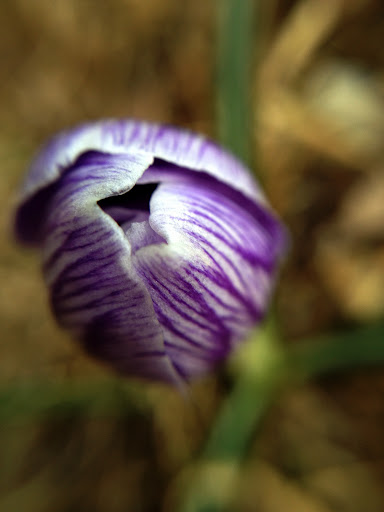
This is the first crocus that made it to the flowering stage in my yard this year. I type this with clenched teeth as I examine the neatly eaten stalks that signify a number of other crocuses may have bloomed already sometime when I wasn’t watching. Something is eating my flowers and I would like to find those crocus-eating creatures (probably a bunny, otherwise known as a hideous, evil, toothy demon) and explain that eating my flowers is not cute. NOT CUTE AT ALL. It results in that throbbing sensation on the right side of my temple. It makes me curse in horribly uncreative ways (you stupid, damn, stupid rabbit!). I want the crocuses to bloom and then experience a natural, withered death without meeting any teeth anywhere in their life cycle. You got that stupid stupid stupid damn bunny? I don’t care if you have a fluffy white tail that makes my last remaining cuteness neuron seize up with awe. Leave my crocuses alone!
This morning, flowers cracked open
the earth’s brown shell. Spring
leaves spilled everywhere
though winter’s stern hand
could come down again at any moment
to break the delicate yolk
of a new bloom.
The crocus don’t see this as they chatter
beneath a cheerful petal of spring sky.
They ignore the air’s brisk arm
as they peer at their fresh stems, step
on the leftover fragments
of old leaves.
When the night wind twists them to pieces,
they will die like this: laughing,
tossing their brilliant heads
in the bitter air.
© 2007 Christine Klocek-Lim