
Author Archives: Christine Klocek-Lim
Snowed in here

but the animals aren’t having any problems.
Quotation fun – Do American poems lack substance?
 In The Hudson Review, Volume LVI, Number 4 (Winter 2004), Bruce Bawer reviews the book Poets Against the War. This book is edited by Sam Hamill and features poems that speak out against the Iraqi war by poets both known and unknown.
The review in pdf form: A Plague of Poets
| Bawer wrote: |
| Throughout these poems,the implicit argument is: Why can’t the whole world be as peaceable as my little corner of it is? The poets appear to believe that their serene lifestyles are somehow a reflection of their own wisdom and virtue; they seem to think they are in possession of some great yet elementary cosmic knowledge from which the rest of us can profit. What they evidently do not realize is that what they are celebrating in these poems is a security for which they have to thank (horrors) the U.S. military and a prosperity that they owe to (horrors again) American capitalism. Entirely absent from their facile scribblings, indeed, is any sign of awareness that this “blue planet” is a terribly dangerous place and that the affluence, safety, and liberty they enjoy, and that they write about with such vacuous selfcongratulation, are not the natural, default state of humankind but are, rather, hard-won and terribly vulnerable achievements of civilization. |
Does living in a country where a lack of open warfare is the norm create a poetry of ignorance?
Is it wrong for poets who live in a peaceable nation to write about or against violence elsewhere in the world?
I don’t think so. However, I believe that such topics as war and violence in a poem must always be approached with caution and a sort of enlightened respect. If we begin limiting the content of poems to those things that one has experienced directly, it would restrict the freedom of speech for which this country’s people have fought, the “hard-won and terribly vulnerable achievements of civilization.”
Your thoughts?
Learning to speak American

{poem removed for revision}
Poem Spark Feb. 5-19 – the Ghazal
 Greetings fellow poets!
This week’s poem spark is dedicated to Esther. Without her help, the Poem Spark section on Poets.org’s discussion forum would not have such a fabulous index, Poem Spark List, nor would it still be going strong, twice a month. She is also responsible for a plethora of new poem spark ideas in the thread, Poem Spark Ideas take two! Thank you Esther!
~~~~~
The ghazal is a lovely poetic form that focuses on love, longing, melancholy, spirituality, philosophical questions, and other similar topics. The use of repetition and rhyme make it suitable for song, both traditionally and today. To learn a bit more of the history of this type of poem, Poets.org’s page Poetic Form: Ghazal has an excellent essay about the form. Here’s an excerpt that explains how ghazals are written:
| Poets.org wrote: |
| The ghazal is composed of a minimum of five couplets–and typically no more than fifteen–that are structurally, thematically, and emotionally autonomous. Each line of the poem must be of the same length, though meter is not imposed in English. The first couplet introduces a scheme, made up of a rhyme followed by a refrain. Subsequent couplets pick up the same scheme in the second line only, repeating the refrain and rhyming the second line with both lines of the first stanza. The final couplet usually includes the poet’s signature, referring to the author in the first or third person, and frequently including the poet’s own name or a derivation of its meaning. |
Upon further research, I discovered an interview of Robert Bly in which he talks about the ghazal: An Interview with Robert Bly
He has some interesting things to say about the syllabic structure of the form and how it translates from Persian and Arabic to English. Bly’s ghazal, embedded in the transcript of the interview is worth reading. His discussion about the ghazal, beyond structure and into the meaning of this type of poem, is illuminating.
In the interview, Bly says: I’ve mentioned that the ghazal often makes a leap to a new subject matter with each new stanza; that is itself a form of wildness. This intrigues me: the idea that the constraints of this form allow a poet to explore topics that may be too difficult, too wild to grapple with in another way. The ghazal seems to provide the ability to leap from one idea to another, from stanza to stanza.
Here are some examples of ghazals, beginning with an essay that contains several in the text:
from Triplopia: The Ghazal: An Inevitable Unity by Jenny Burdge — look for John Hollander‘s “Ghazal on Ghazals” and Denise Duhamel‘s “Bra Ghazal.”
Agha Shahid Ali Even the Rain
Heather McHugh Ghazal of the Better-Unbegun
This week’s spark: write a ghazal. Be creative. Have fun!
new work in Concelebratory Shoehorn Review
I’ve a few poems and photos in the second issue of Concelebratory Shoehorn Review. The editor, Maurice Oliver, has done some really nice work with this issue and I’m very pleased to be included. Check out some of the original artwork, too. I was particularly taken with Magyar’s paintings.
Snow!

Poem Spark Jan. 22-Feb. 5 – the Sonnenizio

Salutations!
I encountered my first Sonnenizio accidentally (reading a submission from a contributor), and fell in love with the idea of this form. It was only after I did some investigation did I learn that the form was invented by Kim Addonizio. A Sonnenizio appears in her book, What Is This Thing Called Love. I sent her an email about her poem, asking if she invented the form and she replied: “yes, it’s true I invented it.” In the email, she included a footnote on the poem:
| Addonizio wrote: |
| Note: the sonnenizio was originated in Florence in the thirteenth century by Vanni Fucci as an irreverent form whose subject was usually the impossibility of everlasting love. Dante retaliated by putting Fucci into the seventh chasm of the Inferno as a thief. Originally composed in hendecasyllabics, the sonnenizio gradually moved away from metrical constraints and began to tackle a wider variety of subject matter. The sonnenizio is 14 lines long. It opens with a line from someone else’s sonnet, repeats a word from that line in each succeeding line of the poem, and closes with a rhymed couplet. |
Upon further investigation on the internet, some sources claim she was inspired to invent the form because Billy Collins invented the Paradelle, a parody of the Villanelle. Apparently, as did Billy Collins for his Paradelle, Addonizio also invented the history for the Sonnenizio form (although she made no mention of this in her email).
Here is a lovely essay by Theresa Edwards about Addonizio’s poem, “Sonnenizio on a Line From Drayton”: Kim Addonizio’s Playful Repetition to Michael Drayton’s Sonnet. Here is a link to Drayton’s Sonnet: LXI of his sonnet series Idea.
By now, I’m sure you know what this week’s spark is: write a Sonnenizio! Every Sonnenizio opens with a line from someone else’s sonnet. A word from this first line is repeated in each succeeding line, then the poem closes with a rhymed couplet.
Here are some examples of other Sonnenizios:
Anna Evans Sonnenizio On A Line from Millay
Arlene Ang Sonnenizio on a Line from Wendy Cope
Here are some sonnets to use as a starting point:
Robert Lowell History
Rainer Maria Rilke Sonnet 6
E.E. Cummings Sonnets/Unrealities III.
Have fun! Be creative.
In memory of

Brutally, the robin
bites the ground, digs
at the sharp grass with stubborn
instinct. The worms are dead
in the frailty of winter. Sorrow
blossoms easily, like feathers
on snow. I have no memory
of your hands. Only the difficult
tilt of your head (your jaw as stubborn
as a bird’s beak) flutters to the surface
of my thoughts. It is January, inside this house.
I am steady until the robin ends his futile movements
and flies into the woods, away from my clouded window.
In the distance, even the specks of his wings vanish
though my yard clutches a few stray feathers;
brown against the indecent white of snow.
© 2007 Christine Klocek-Lim
Poem Spark Jan. 8-15 – Inspired by . . .
First line from Paula Bohince’s poem titled, “Brutally, the Robin”
Finally
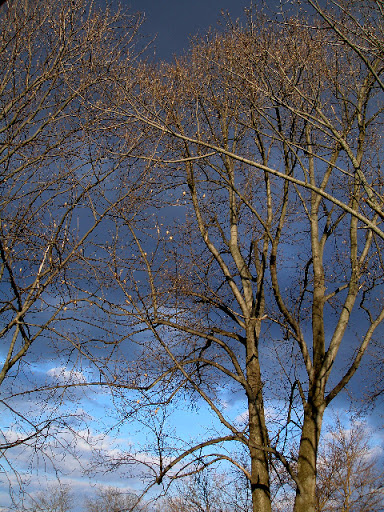 . . . it feels like January. It’s 34 degrees Fahrenheit right now.
 Christine Klocek-Lim