
14 pages yesterday. 16 pages today. I can see why writing a novel takes so freaking long. It feels like only a few minutes have passed, but in reality it’s been three hours. And now my left eye is twitching. Time to stop, exercise, eat lunch.
Author Archives: Christine Klocek-Lim
Busy, busy
Well, things have been busy in my household the past week or so. There’s a lot of end-of-the-school year stuff to deal with when you have two kids. My mom also ended up in the hospital (she’s okay, and doing better now), but that also ate up my time. So no new photos or poems recently. Maybe soon.
I just started writing a book. The weirdest thing I’ve discovered is that my hands get tired faster than my thoughts. I wish I could plug the computer directly into my head and then I could skip the typing altogether. Maybe I just need to grow muscles in my hand or something. Oh well.
Quotation fun – Do poems in the midst of prose scare you?
 Finally I’ve had a few moments to myself after the craziness of real life the last five days. So, what did I do today? Did I read a magazine? No. Did I watch Oprah? No. Instead, you guessed it: I read articles about poetry.
Today I discovered this interview of Ted Kooser in the South Bend Tribune. Now, I’ve listened to Ted before on the radio and read some other interviews so not much of what he said was new to me. Rather, something he said and has been saying in many different ways and forms over the years struck me again as being very insightful:
| Ted Kooser wrote: |
| Prose is more hospitable toward readers. We pick up something in prose and are reading it before we notice we are. Poetry is rarely like that. When we see something set in type that looks like a poem, we have to consciously address ourselves to it. |
I instinctively know he’s right about this. Of course, that doesn’t mean anything except I’ve got an opinion just like everyone else. However, I will admit a guilty secret that I think applies to this quote: I skip over poems when they are embedded in prose. In fact, I skip over them even when they appear at the head of a chapter in a novel or any other type of book.
For some reason, I like my poems to appear naked, on their own page. I dislike trying to read a poem and then somehow relate it to a passage of prose because I think poems should be respected in their own right, as a work of art. And they scare me when they appear in a mess of words, because then I must slow down and pay attention to the poem. It’s much easier to skip over it as I read the prose in my usual speed-reading fashion, like chomping down a whole bag of potato chips. The poems are more like very expensive chocolate: meant to be savored and appreciated slowly.
Do you skip the poems in books? Do you find poems more intimidating than prose?
.
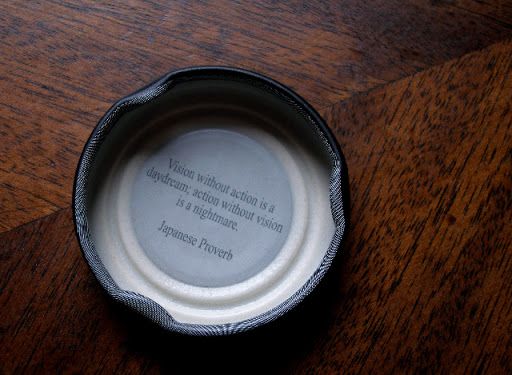
Vision cap
May 6 Pedestal Reading Event – Manayunk Art Center
Editor John Amen will host a Pedestal Magazine event at the Manayunk Art Center in Philadelphia, PA on May 6, 2007 starting at 3PM. This event is sponsored by Peter Krok, humanities and poetry director of the Manayunk Art Center and editor of Schuylkill Valley Journal. Participants will include Arlene Bernstein, Christine Klocek-Lim, Peter Krok, Anna Evans, Dan Maguire, John Bourne, Adele Bourne, Yvonne Chism-Peace, John Capista, Amy Small-McKinney, Rosemary Cappello, Eileen D’Angelo, Kelley White, and Tree Riesener.
Poem Spark Apr. 30-May 14 – the Sevenling

Greetings and Salutations fellow poets!
After spending the month of April writing a poem each day in celebration of National Poetry Month, I discovered how difficult it was to create something original with such demanding time constraints. Across the internet, various poets used different strategies for sparking the poetic muse. One such spark is a form of poem called the Sevenling.
Here’s a small explanation of the sevenling by the form’s creator, Roddy Lumsden, courtesy of The American Poetry Journal:
| Lumsden wrote: |
| The rules of the sevenling are thus:
The first three lines should contain an element of three – three connected or contrasting statements, or a list of three details, names or possibilities. This can take up all of the three lines or be contained anywhere within them. Then, lines four to six should similarly contain an element of three, connected directly or indirectly or not at all. The seventh line should act as a narrative summary or punchline or as an unusual juxtaposition. There are no set metrical rules, but being such as short form, some rhythm, metre or rhyme is desirable. To give the form a recognisable shape, it should be set out in two stanzas of three lines, with a solitary seventh, last line. Titles are not required. A sevenling should be titled Sevenling followed by the first few words in parentheses The tone of the sevenling should be mysterious, offbeat or disturbing, giving a feeling that only part of the story is being told. The poem should have a certain ambience which invites guesswork from the reader. |
The form is based on a much-translated poem by Anna Akhmatova:
American Poetry Journal excerpt of “He loved. . .”, translated by D.M. Thomas
The Harvard Advocate excerpt of “He loved. . .”, translated by Judith Hemschemeyer
Here are some other excellent sevenlings:
Yolanda Calderon-Horn 4 Sevenlings
Diane Thiel Sevenlings for Akhmatova
Your poetry spark for the next two weeks is: write a sevenling. Be creative and have fun!
 Christine Klocek-Lim