miPOradio: The Countdown

Catch Episode 15 of The Countdown, miPOradio‘s poetry show:

powered by ODEO

This show features poems by:

Riley Dog –
“Chemotherapy Omnibus”

Laurel K. Dodge –
“The Bough Has Broken”

David Raphael Israel –
“One Side of the Heart”

Erica W. Adams
42 Opus –
“Panegyrize”

Mark Young –
“so maybe there”

Christine Klocek-Lim –
“Tonight I Walked Into the Sunset”

Alison Stine –
No Tell Motel
“After Meat”

Amy King –
“Causes for Celebration”

Jill Chan –
The Eye

Poem Spark Sept. 25-Oct. 2 – Syllabic Verse

Greetings and salutations!

Today, I found myself thinking about line length. There are so many different ways of using the line to enhance your poem: you can decide to use short or long lines or a combination of both to control the pacing, you can focus on which words you’d prefer to end a line to put particular emphasis on the most important, you can consider whether or not to enjamb which also can determine the rhythm of the poem, and/or you can rhyme the end words to give the poem interesting sonics. There are many other considerations I’ve neglected to list.

I believe that focusing on the number of syllables in each line can open up the way you think about your poems: using a set number of syllables can make all your lines long or short, can force you to be creative with end-words, can make you consider enjambment in a new light. Because you are placing a mechanical framework upon your words, you find that you sometimes pay a lot more attention to the words you choose to form an idea than you might if you were writing freely.

Some of the most famous examples of syllabic verse are the Japanese forms of haiku, and tanka. Additionally, there is the Alexandrine, a French syllabic form where each line has twelve syllables and generally one caesura.

Because English does not traditionally have many forms that use syllabics (mostly because English is accentually, rather than syllabically, rhythmic) does not mean that there aren’t great poems written where the poet counted his/her syllables. Here are a few:

Philip Levine What Work Is (averages 9 syllables per line)

Marianne Moore To a Steam Roller (each stanza follows a syllabic form: 5-12-12-15)

Dylan Thomas Fern Hill (you tell me what the syllabics in this poem are!)

This week’s spark: write a syllabic poem. Have fun!

Poetry equals shoes

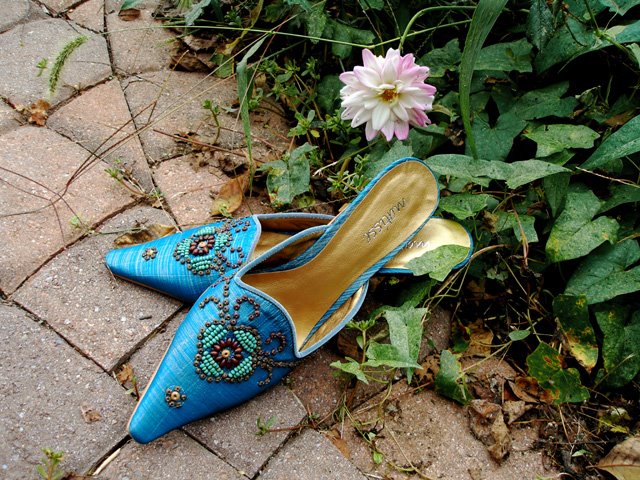
I received a “Commended Award” in the 2006 Margaret Reid Contest for Traditional Verse. This means that I won $50, which = shopping, which = new shoes!

And here’s the winning poem:


“Tonight I walked into the sunset”

—sonnet for Georgia O’Keeffe

Here the fragile white of age-bleached skull
curves through a hinge of jaw like youthful skin,
and there, two restless eyes seem fraught with all
she could not say. She didn’t paint within
the lines, couldn’t choose the safe belief
that everything is simple. Stark as grief
her violet buildings rise beneath a moon
so white that bone shows through. There the noon
sun lights the mountains. Here you see how hands
crack wide her heart: she painted sound, used blood
to mark the earth. Because she knew that strands
of life are drawn of clay and bone, not mud,
she wrote: “so give my greetings to the sky. . .”
And in her art the skulls nod in reply.

© 2006 Christine Klocek-Lim

Poem Spark Sept. 18-25 – E. E. Cummings

Salutations fellow poets!

Recently, a member of the Poets.org forum suggested I create a poem spark based on one of E. E. Cummings’ paintings. Before reading that suggestion, I didn’t realize that Cummings was also a prolific painter. You can look at some of his work here: The Paintings of E. E. Cummings.

This made me think, “What else don’t I know about Cummings? Or other poets?” I did some more investigation, and uncovered this interesting tidbit: Cummings never wanted his name to appear in lowercase. You can find the article about that interesting fact here: Not “e. e. cummings”

There is even more information about Cummings’ poetic work available at Poets.org here: E. E. Cummings

Fascinating stuff. There must be more that I don’t know about so many poets; information that is readily available on the web if one looks for it. So, I will be using the poem spark to do a “poet focus” every now and again. There is always more to learn about poetry, and poets, and the history of this art.

However, to get back to Cummings, I’m sure everyone knows his work in poetry uses huge leaps of imagination with punctuation, form, words, etc. Sometimes, the exhuberant nature of his poetry almost overwhelms the sense of it, but not always. Underneath his marvelous fascination with the visual and the innovative lies the seed of a great voice.

Here are some of my favorite Cummings’ poems, each with a singular message that threads the pieces of the poems’ language into a coherent whole:

next to of course god america i

somewhere i have never travelled,gladly beyond

pity this busy monster,manunkind,

And here is one of E. E. Cummings’ paintings I particularly like:

lone figure and tree in stormy sunset

This week, write a poem using E. E. Cummings style (innovative punctuation, etc.) OR write a poem inspired by the painting I linked to above, “lone figure and tree in stormy sunset.” Most of all, be creative and have fun!
Poem Spark Sept. 11-18 – Poem titles

Greetings and Salutations fellow poets!

Today’s poem spark is about one of the more important elements in a poem: the title. So many times I’ve decided to read a poem because it had an interesting title, or decided not to read a poem because the title seemed, well, boring. It is the very first thing a reader sees, whether in a table of contents, in a list of poems online, or at the start of a book of poems, not to mention when beginning to read a poem. As such, the title is an extremely useful device for opening a conversation with your reader. As Ted Kooser states in his book, “The Poetry Home Repair Manual:”


Ted Kooser wrote:
. . . a title isn’t something you stick on just because you think a poem is supposed to have one. Titles are very important tools for delivering information and setting expectations.


Thinking about poem titles, I went to Google, typed in “poem titles” and found this page: Writing the River – Poem Titles. Look at how many interesting titles are listed. Titles like this one, “During the Long Wait These Dreams” and this one, “even when the moon don’t shine” make me wonder what those poems are about. They are intriguing and interesting.

Here are some poems with titles that encourage me to continue the conversation and read the poem:

Heather McHugh What He Thought

Lawrence Ferlinghetti [Constantly Risking Absurdity]

James Wright Goodbye to the Poetry of Calcium

Sometimes titles begin a poem as its first line:

William Stafford Traveling Through the Dark

Henry Reed Naming of Parts

Sometimes a poem ends with its title:

Michael S. Harper Nightmare Begins Responsibility

Stevie Smith Not Waving But Drowning

This week, write a poem that uses either its first line or last line (or phrase) as its title. Have fun and be creative!

Best American Poetry 2006

Here is a link to the Best American Poetry 2006 Table of Contents:

Best American Poetry 2006

If you scroll down, you will see that Reb Livingston’s poem, “That’s Not Butter” was chosen. That poem first appeared in MiPoesias, an online journal created by Didi Menendez and edited by Amy King.

Does this mean that the online poetry community has finally caught up with print journals? Perhaps.